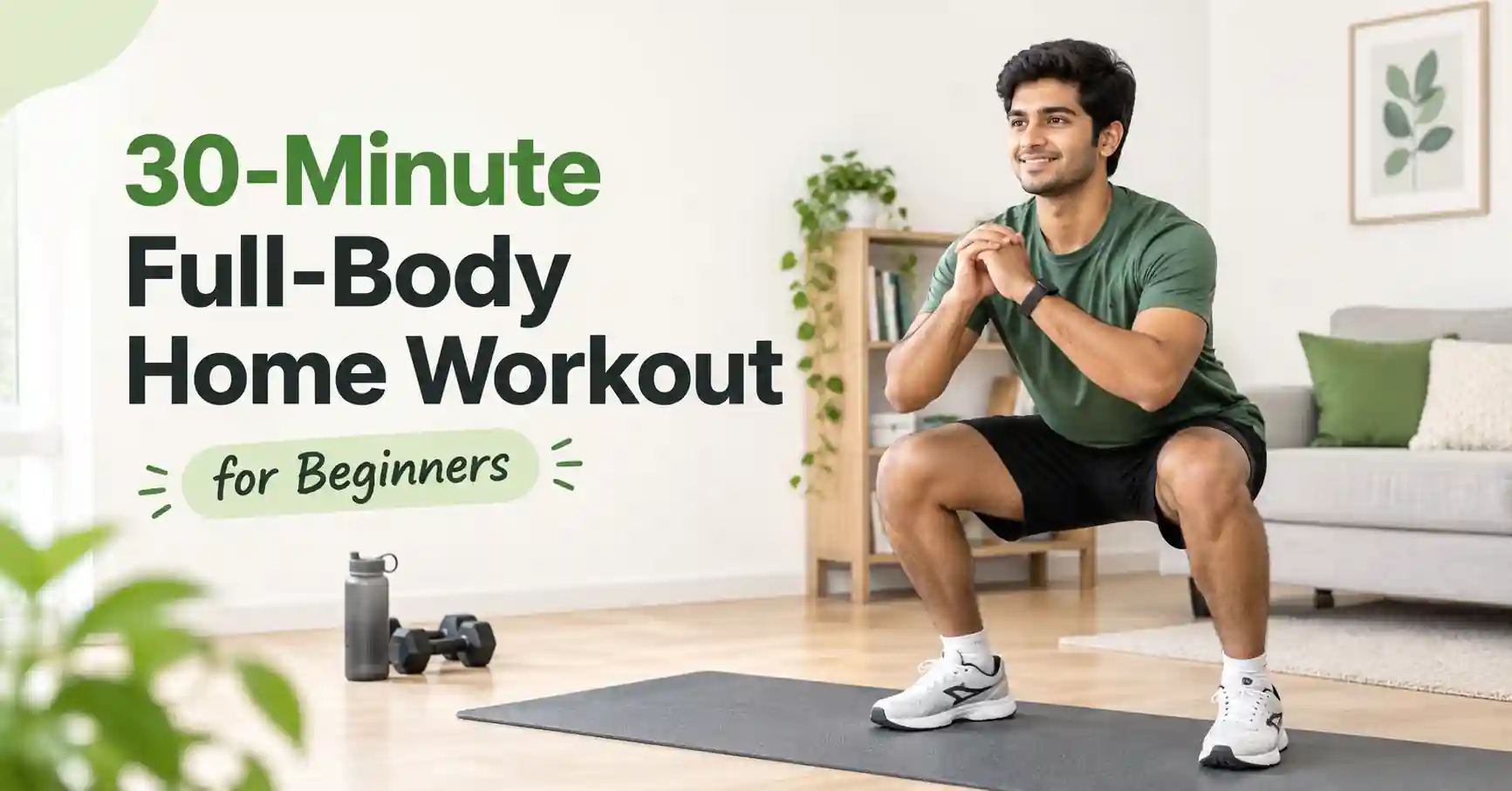
30-Minute Full-Body Home Workout for Beginners
A 30-minute full-body home workout for beginners can give you a simple starting point for building strength, movement skills and exercise consistency.
But there is an important question beginners often overlook:
What should you actually aim for during those 30 minutes?
The goal should not be to finish as exhausted as possible. Instead, aim to move with good technique, challenge the major muscle groups, control your intensity and finish the session feeling like you could gradually do more over time.
This guide explains how to structure a practical 30-minute workout, which exercises to choose, how hard to work, what to do if an exercise is too difficult and how to build your routine from week to week.
Disclaimer: This guide is for general fitness information and is not a substitute for individualized medical or professional exercise advice. If you have an injury, medical condition, or are unsure whether an exercise is suitable for you, consult an appropriate healthcare professional before starting.
Table of Contents
- What Should You Aim for in a 30-Minute Workout?
- How to Structure Your 30-Minute Full-Body Home Workout
- 5-Minute Beginner Warm-Up
- 20-Minute Full-Body Workout
- How Hard Should Beginners Work?
- Beginner Modifications for Each Exercise
- 5-Minute Cool-Down
- How Many Days a Week Should You Do This Workout?
- A Simple 7-Day Beginner Workout Schedule
- How to Progress After the First Few Weeks
- Common Beginner Mistakes
- Frequently Asked Questions
- Build Your 30-Day Better Living Routine
- Final Takeaway
What Should You Aim for in a 30-Minute Workout?
A good beginner workout is not measured only by how sweaty or tired you feel.
Instead, aim for five things:
- Good movement technique
- A manageable level of effort
- Full-body movement
- Gradual progression
- Consistency from week to week
A 30-minute session can be structured around a warm-up, a main workout and a short cool-down. This approach is also reflected in several of the leading home-workout resources reviewed for this topic. HABUILD, for example, structures its 30-minute session around a warm-up, main circuit and cool-down, while Verywell Fit uses a short warm-up followed by a full-body resistance workout.
For a beginner, the biggest win is not completing the hardest possible workout.
It is creating a workout you can repeat, improve and eventually make part of your routine.
How to Structure Your 30-Minute Full-Body Home Workout
A simple structure is:
| Workout Section | Time | Main Goal |
| Warm-up | 5 minutes | Prepare your body |
| Full-body workout | 20 minutes | Strength and movement |
| Cool-down | 5 minutes | Gradually reduce intensity |
| Total | 30 minutes | Complete session |
You do not need complicated equipment for the basic version.
A small amount of floor space, comfortable clothing and water are enough to get started.
If you eventually want more resistance, you can introduce bands or light dumbbells as your technique and fitness improve.
5-Minute Beginner Warm-Up
Before beginning the main workout, spend around five minutes gradually getting your body moving.
1. March in Place — 60 Seconds
Stand tall and march at a comfortable pace.
Move your arms naturally and gradually increase your pace.
2. Arm Circles — 30 Seconds
Make controlled circles with your arms.
Avoid fast or aggressive movements.
3. Shoulder Rolls — 30 Seconds
Roll your shoulders slowly backward and then forward.
4. Hip Circles — 30 Seconds
Place your hands on your hips and make small controlled circles.
5. Bodyweight Squats — 60 Seconds
Perform slow, comfortable squats.
If necessary, squat toward a chair rather than lowering deeply.
6. Alternating Step-Backs — 60 Seconds
Step one foot backward at a time and return to standing.
Keep the movement controlled.
7. Gentle Movement — 30 Seconds
Finish with light marching or walking around your workout area.
The purpose of the warm-up is to prepare for exercise—not to tire yourself out before the workout begins.
20-Minute Full-Body Workout
For your first few sessions, focus on quality rather than speed.
Complete the following exercises as a circuit.
A beginner-friendly starting point can be:
40 seconds of exercise + 20 seconds of rest
Complete the circuit twice.
If 40 seconds feels too demanding, work for 20–30 seconds instead.
1. Bodyweight Squats
Squats train the muscles around your legs and hips while also practicing a movement pattern used in everyday activities.
How to do it:
- Stand with your feet around shoulder-width apart.
- Keep your chest comfortable and your core gently engaged.
- Push your hips backward.
- Bend your knees and lower yourself.
- Push through your feet to return to standing.
Beginner option: Use a chair behind you and perform controlled chair squats.
If you want more variations, see our guide to bodyweight exercises for beginners.
2. Incline Push-Ups
You do not need to begin with traditional floor push-ups.
Place your hands on a sturdy elevated surface such as a stable countertop or wall and perform an incline push-up.
How to do it:
- Place your hands slightly wider than shoulder-width.
- Keep your body in a controlled line.
- Bend your elbows.
- Lower your chest toward the surface.
- Push back to the starting position.
Beginner option: Use a wall.
Progression: Move from wall push-ups to a lower stable surface and eventually to floor push-ups.
3. Glute Bridges
Glute bridges are a simple way to train the muscles around your hips and posterior chain.
How to do it:
- Lie on your back.
- Bend your knees.
- Keep your feet flat on the floor.
- Brace your core gently.
- Lift your hips.
- Pause briefly at the top.
- Lower slowly.
Avoid rushing the movement.
4. Reverse Lunges
Reverse lunges challenge the legs while also requiring balance and coordination.
How to do it:
- Stand tall.
- Step one foot backward.
- Lower yourself in a controlled manner.
- Push through the front foot.
- Return to standing.
- Alternate sides.
Beginner option: Hold onto a sturdy support for balance.
If lunges feel uncomfortable, reduce the range of motion or use supported step-backs.
5. Standing or Supported Row
A balanced full-body routine should include a pulling movement as well as pushing movements.
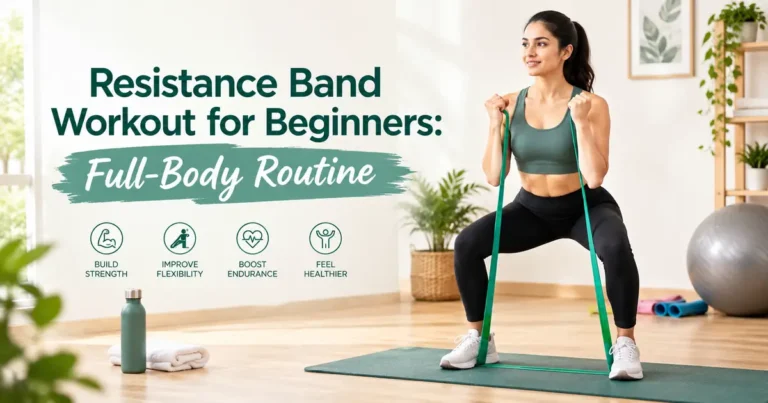
If you have a resistance band, you can perform a band row.
Alternatively, you can use a suitable household setup only if it is stable and safe.
Beginner option: Start with a resistance band and light resistance.
As you progress, our resistance band workout for beginners can help you move toward a more structured resistance routine.
6. Standing Shoulder Press
If you have light dumbbells, you can perform a standing shoulder press.
If you do not have weights, skip the weighted version rather than replacing it with an unstable household object.
How to do it:
- Stand tall.
- Hold light weights at shoulder level.
- Press them upward.
- Keep the movement controlled.
- Lower them slowly.
The weight should allow you to maintain good technique.
7. Bird Dog
Bird dog combines balance, core control and coordinated movement.
How to do it:
- Start on your hands and knees.
- Keep your spine in a comfortable neutral position.
- Extend one arm and the opposite leg.
- Pause briefly.
- Return to the starting position.
- Switch sides.
Move slowly rather than trying to complete as many repetitions as possible.
8. Standing March or Step Jacks
Add a simple movement that increases your breathing rate.
For a low-impact option, march in place.
If comfortable, use step jacks instead of jumping jacks.
The goal is to keep moving without losing control.
9. Elevated Plank
Core training does not require you to immediately hold a floor plank.
Place your hands on a stable elevated surface and hold your body in a controlled position.
Beginner option: Wall plank.
Progression: Countertop plank → lower elevated plank → floor plank.
Stop if you cannot maintain good form.
10. Slow Bodyweight Squats
Finish the circuit with another set of controlled squats.
This time, focus on your movement quality.
Lower yourself slowly, pause briefly if comfortable and return to standing.
Do not rush simply because you are approaching the end of the workout.
How Hard Should Beginners Work?
This is one of the most important parts of a beginner workout.
You do not need to train until you are completely exhausted.
Instead, aim for a level of effort that feels challenging while still allowing you to maintain reasonable technique.
A useful beginner rule is:
Finish the set feeling challenged, but not completely depleted.
If your technique starts falling apart, slow down or stop the set.
Verywell Fit recommends beginners start with no weight or light weights and fewer sets before progressing, while Healthline similarly presents scalable beginner movements before advancing toward harder variations.
Your first goal should be control
Before increasing:
- repetitions
- resistance
- workout speed
- exercise difficulty
first improve your technique.
That creates a stronger foundation for progression.
Beginner Modifications for Each Exercise
One of the biggest advantages of exercising at home is that you can adapt the workout to your current ability.
| Exercise | Easier Option | Progression |
| Squat | Chair squat | Slow/tempo squat |
| Push-up | Wall push-up | Floor push-up |
| Glute bridge | Basic bridge | Single-leg progression |
| Reverse lunge | Supported step-back | Regular reverse lunge |
| Row | Light resistance band | Stronger resistance |
| Shoulder press | Very light weights | Gradually increase resistance |
| Bird dog | Move one limb at a time | Longer controlled holds |
| March | Slow march | Faster march/step jack |
| Plank | Wall plank | Floor plank |
| Squat | Reduced range | Deeper controlled squat |
The goal is not to prove that you can perform the hardest variation.
The goal is to choose the version that allows you to perform the movement safely and consistently.
5-Minute Cool-Down
After the main workout, gradually reduce your pace.
You can spend approximately five minutes walking slowly around your room and performing comfortable mobility movements.
For example:
- Slow walking
- Shoulder rolls
- Gentle chest opening
- Standing side stretch
- Gentle quadriceps stretch
- Hamstring stretch
- Calf stretch
- Slow breathing
Avoid forcing a stretch.
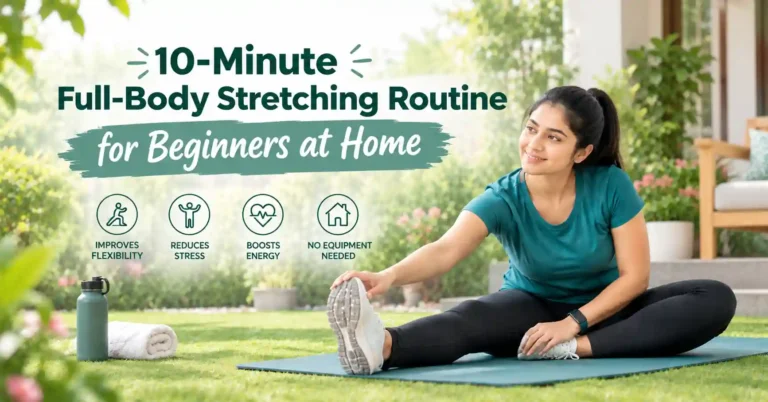
If you want a more detailed flexibility routine, see our beginner stretching routine.
How Many Days a Week Should You Do This Workout?
For many beginners, 2–3 full-body strength sessions per week can be a practical starting point.
You do not have to perform this exact 30-minute workout every day.
Instead, combine strength sessions with other forms of movement.
Current CDC guidance recommends that adults aim for at least 150 minutes of moderate-intensity aerobic activity each week, along with muscle-strengthening activity on at least 2 days per week. The activity can also be divided into smaller periods, and some activity is better than none.
That means your weekly activity could include:
- Full-body strength workouts
- Brisk walking
- Cycling
- Mobility or stretching
- Other enjoyable physical activities
The 30-minute workout is therefore one part of your weekly movement routine, not the entire definition of fitness.
A Simple 7-Day Beginner Workout Schedule
Here is one practical example:
| Day | Activity |
| Monday | 30-minute full-body workout |
| Tuesday | 20–30 minute walk |
| Wednesday | Rest or gentle stretching |
| Thursday | 30-minute full-body workout |
| Friday | Walking or light activity |
| Saturday | Optional light workout or walk |
| Sunday | Rest |
If you are completely new to exercise, start with two workout sessions and gradually build your routine.
There is no need to begin with a demanding seven-day program.
How to Progress After the First Few Weeks
Once the workout begins feeling manageable, you can gradually increase the challenge.
1. Improve Your Technique
Before making an exercise harder, make sure you can perform it with control.
2. Increase Repetitions
If you are comfortably completing your current workload, add a few controlled repetitions.
3. Increase Work Time
You might progress from 30 seconds of work toward 40 seconds.
4. Reduce Rest Gradually
Only reduce rest if you can still maintain good technique.
5. Add Resistance
Resistance bands or light dumbbells can make familiar exercises more challenging.
6. Progress the Exercise
For example:
Wall push-up → incline push-up → knee push-up → regular push-up
The same principle can be applied to squats, lunges and planks.
7. Keep the Routine Sustainable
More difficult does not automatically mean better.
Your progression should leave you capable of returning for the next session.
Common Beginner Mistakes
Trying to Exercise Every Day
More workouts are not automatically better.
Recovery is part of training.
Starting Too Hard
If your first workout leaves you unable to comfortably move for several days, your starting point may have been too aggressive.
Chasing Sweat
Sweating does not tell you whether a workout was appropriate or effective for your individual goal.
Ignoring Technique
Fast repetitions performed with poor control are not a useful substitute for controlled movement.
Copying Advanced Workouts
A workout designed for an experienced exerciser may not be appropriate for someone starting from zero.
Expecting Immediate Results
Fitness develops over time.
Track improvements in strength, movement confidence, energy and consistency—not only appearance.
Giving Up After Missing a Session
Missing one workout does not erase your progress.
Simply return to your next planned session.
This is especially important because consistency is a separate skill from workout programming. Our guide on how to stay consistent with exercise covers practical ways to build that habit.
Frequently Asked Questions
Is 30 minutes enough for a full-body home workout?
Yes, 30 minutes can provide enough time for a structured workout covering major movement patterns. However, one 30-minute session should be viewed as part of your overall weekly activity rather than your entire fitness routine.
Adults are generally advised to accumulate at least 150 minutes of moderate-intensity aerobic activity each week and perform muscle-strengthening activities on at least two days.
Can beginners do a full-body workout at home without equipment?
Yes. Bodyweight exercises can provide a practical starting point for beginners. Exercises such as squats, bridges, push-up variations, lunges and planks can be modified according to your ability. Healthline’s current at-home workout guide similarly presents bodyweight exercises that progress from beginner to more advanced variations.
How many times a week should a beginner do a full-body workout?
Two or three sessions per week can be a reasonable starting structure for many beginners, with recovery or other forms of movement between sessions.
Your individual needs may differ based on fitness level, health, schedule and goals.
Should beginners exercise every day?
Not necessarily.
Daily movement such as walking can be useful, but you do not need to perform the same demanding strength workout every day. Build a weekly routine that includes training, lighter movement and recovery.
What if I cannot complete all the exercises?
Modify them.
Use wall push-ups instead of floor push-ups, chair squats instead of deeper squats, supported lunges instead of unsupported lunges, and shorter work intervals when necessary.
An appropriate modification is better than forcing a movement you cannot control.
Can I lose weight with a 30-minute home workout?
A 30-minute workout can contribute to an active lifestyle, but weight change depends on multiple factors, including overall physical activity and dietary intake. There is no single workout that guarantees weight loss.
Avoid judging the success of your workout only by the number on the scale.
When should I make my workout harder?
Progress when your current version feels manageable and you can perform it with good technique.
Increase only one variable at a time—for example, repetitions, resistance, work duration or exercise difficulty.
Build Your 30-Day Better Living Routine
You don’t need an extreme workout plan to become more active.
What matters is creating a routine that fits your life and gives you a practical way to track your progress.
Download the 30-Day Better Living Planner from InfuseUrLife and track your workouts, walking, stretching, daily movement and healthy habits throughout the month.
[Download the 30-Day Better Living Planner]
Small actions. Consistent effort. A better routine.
Live better. Live smarter. Every day.
Final Takeaway
A 30-minute full-body home workout for beginners should not be about seeing how much punishment you can tolerate.
It should give you a simple structure that you can repeat.
Start with:
5 minutes of warm-up → 20 minutes of full-body movement → 5 minutes of cool-down.
Choose beginner-friendly exercise variations. Focus on technique. Adjust the intensity when necessary. Give your body time to recover, and gradually increase the challenge as your fitness improves.
Most importantly, remember that a 30-minute workout is a starting point—not a test of how fit you should already be.
The best workout is one that you can perform safely today and still feel ready to return to tomorrow.
References:
Adult Activity: An Overview
What Counts as Physical Activity for Adults
Fitness Program: 5 Steps to Get Started
30-Minute Full Body Workout You Can Do at Home