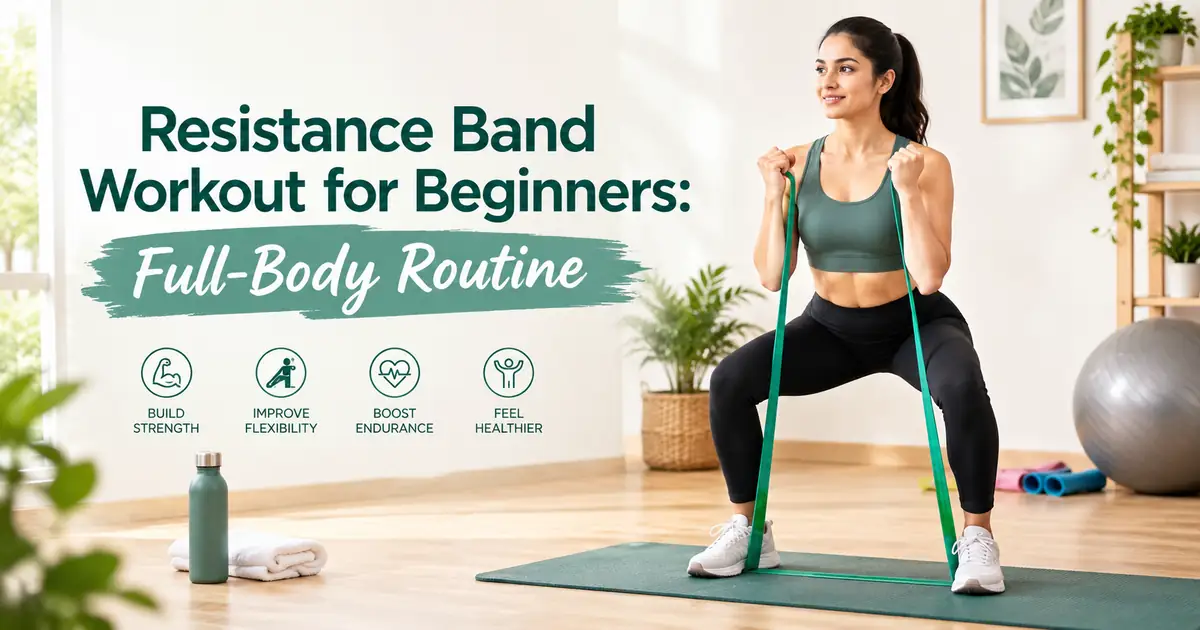
Resistance Band Workout for Beginners: Full-Body Routine
A resistance band workout can be a simple way for beginners to start strength training at home without needing a full set of weights or a large workout space. With the right exercises, one resistance band can help you train your legs, glutes, back, chest, shoulders, arms and core.
The key is not to make your first workout complicated. You need manageable resistance, controlled movements, good technique and enough recovery between sessions.
This beginner-friendly full-body routine gives you a practical place to start. You’ll learn how to choose resistance, warm up, perform eight fundamental exercises, modify difficult movements, progress over time and build a simple weekly routine.
Important: This Blog Post provides general fitness information, not individualized medical advice. If you have a medical condition, recent injury, significant pain, or specific exercise restrictions, speak with an appropriate healthcare professional before beginning a new exercise program.
Table of Contents
- Why Try a Resistance Band Workout?
- What You Need for a Beginner Resistance Band Workout
- How to Choose the Right Resistance Band
- Warm Up Before Your Resistance Band Workout
- Resistance Band Workout for Beginners: Full-Body Routine
- Beginner Modifications
- How Many Sets and Reps Should Beginners Do?
- How Often Should You Do a Resistance Band Workout?
- How to Progress Your Resistance Band Workout
- Common Resistance Band Workout Mistakes
- Resistance Band Safety Tips
- Frequently Asked Questions
- Build Your 30-Day Better Living Routine
- Final Takeaway
Why Try a Resistance Band Workout?
Resistance bands are portable, relatively inexpensive and easy to store, making them practical for home workouts. They can also provide resistance through different parts of an exercise’s range of motion.
The American Council on Exercise describes resistance bands as a versatile option for resistance training and notes that their tension increases as the band stretches. It also emphasizes that bands are one effective training option rather than automatically being better than free weights or machines.
For a beginner, that flexibility can be useful.
A well-designed resistance band workout at home can help you practice fundamental movement patterns such as:
- Squatting
- Hip hinging
- Pulling
- Pushing
- Pressing
- Arm flexion and extension
- Core stabilization
You also don’t need to start with an advanced program.
The CDC includes resistance-band exercises among muscle-strengthening activities and recommends that adults perform muscle-strengthening activities involving all major muscle groups on at least two days each week.
If you’re completely new to exercise, start gradually. Consistency matters much more than trying to make your first session exhausting.
What You Need for a Beginner Resistance Band Workout
You don’t need a complicated home gym.
For this routine, you can start with:
- One long resistance band
- A comfortable exercise surface
- Enough open space to move safely
- Optional handles, depending on the band
- Optional door anchor for exercises designed to use one
Different bands serve different purposes.
Long resistance bands
These are versatile and can be used for squats, rows, presses, curls and several other movements.
Loop bands
These form a continuous loop and are particularly useful for lower-body exercises such as glute bridges and lateral movements.
Mini bands
These smaller loop bands are commonly used around the thighs or legs for lower-body exercises.
Tube bands with handles
These can make certain pressing and pulling movements easier to set up, especially when combined with an appropriate anchor.
You don’t necessarily need every type.
For a beginner, start with a band that allows you to complete your exercises with controlled technique and an appropriate level of effort.
How to Choose the Right Resistance Band
Resistance bands are commonly sold in different resistance levels, but the exact tension can vary between brands and band types.
Instead of choosing a band simply because it says “light,” “medium” or “heavy,” consider how the band feels during the actual exercise.
A suitable resistance should allow you to:
- Maintain good posture.
- Complete the planned repetitions.
- Control both the lifting and lowering phases.
- Reach the end of a set feeling challenged without losing technique.
- Perform the movement through a comfortable range of motion.
The British Heart Foundation recommends using a band with enough stretch to allow you to complete the entire movement and suggests using less resistance if an exercise is too difficult.
Remember that different exercises may require different levels of resistance.
Your legs and glutes may handle more resistance than your shoulders, for example.
Beginner rule: If you have to jerk the band, hold your breath, change your body position dramatically or sacrifice your range of motion to complete a repetition, the resistance is probably too challenging.
Warm Up Before Your Resistance Band Workout
A short warm-up can help you transition from rest into exercise.
Try this simple 5–7 minute beginner warm-up:
| Movement | Duration/Reps |
| March in place | 60 seconds |
| Arm circles | 30 seconds |
| Shoulder rolls | 30 seconds |
| Bodyweight squats | 10 reps |
| Hip hinges | 10 reps |
| Glute bridges | 10 reps |
| Easy band pull-aparts | 8–10 reps |
Keep the warm-up comfortable.
The purpose isn’t to fatigue yourself before the workout. You simply want to move your joints and muscles through the movements you’ll be using.
Resistance Band Workout for Beginners: Full-Body Routine
Now let’s get to the main workout.
This routine contains eight exercises designed to cover the major areas of the body without overwhelming a beginner.
Beginner workout at a glance
| Exercise | Main Focus | Starting Point |
| Resistance band squat | Legs and glutes | 2 × 10–12 |
| Resistance band Romanian deadlift | Glutes and hamstrings | 2 × 10–12 |
| Resistance band row | Back and biceps | 2 × 10–12 |
| Resistance band chest press | Chest and triceps | 2 × 8–12 |
| Resistance band glute bridge | Glutes and hamstrings | 2 × 10–15 |
| Resistance band shoulder press | Shoulders and triceps | 2 × 8–12 |
| Resistance band biceps curl | Biceps | 2 × 10–15 |
| Standing band core press | Core | 2 × 8–12 per side |
Rest approximately 60–90 seconds between sets, or longer if you need it.
The exact number of repetitions isn’t a rule you must force yourself to reach. Your form should determine when you stop.
1. Resistance Band Squat
Targets: Quadriceps, glutes, hamstrings and core
How to perform it:
- Stand on the middle of the band with your feet approximately hip- to shoulder-width apart.
- Hold the band or handles near shoulder height.
- Keep your chest comfortably upright.
- Bend your knees and move your hips back.
- Lower only as far as you can maintain good control.
- Push through your feet to return to standing.
Beginner starting point: 2 sets of 10–12 reps.
Technique cue: Keep your knees tracking in the same general direction as your toes rather than allowing them to collapse inward.
If the band makes the movement too difficult, reduce the tension or practice the squat without the band first.
2. Resistance Band Romanian Deadlift
Targets: Hamstrings, glutes and posterior chain
This exercise teaches an important movement pattern: the hip hinge.
How to perform it:
- Stand on the band with both feet.
- Hold the ends or handles.
- Keep your back in a comfortable neutral position.
- Slightly bend your knees.
- Push your hips backward while keeping the band close to your body.
- Stop when you feel an appropriate stretch through the back of your legs without forcing the movement.
- Drive your hips forward to return to standing.
Beginner starting point: 2 sets of 10–12 reps.
Technique cue: Think “hips back”, not “bend forward.”
Don’t turn this into a fast movement. Control the lowering phase.
3. Resistance Band Row
Targets: Upper back, lats, rear shoulders and biceps
If you’re using an anchor, make sure it is appropriate for the band and securely installed according to the manufacturer’s instructions.
How to perform it:
- Set up the band securely.
- Hold the handles or band ends.
- Keep your torso stable.
- Pull your elbows toward your ribs.
- Bring your hands toward your torso without shrugging your shoulders.
- Pause briefly.
- Slowly return to the starting position.
Beginner starting point: 2 sets of 10–12 reps.
Technique cue: Think about pulling with your elbows rather than simply moving your hands.
4. Resistance Band Chest Press
Targets: Chest, shoulders and triceps
A chest press can be performed using a secure anchor behind you or another appropriate setup supported by the equipment manufacturer’s instructions.
How to perform it:
- Position the band securely behind your body.
- Hold the handles or band ends.
- Start with your hands around chest level.
- Press your hands forward.
- Stop before your elbows lock aggressively.
- Return slowly to the starting position.
Beginner starting point: 2 sets of 8–12 reps.
The British Heart Foundation includes resistance-band pressing exercises in its home resistance-band guidance.
Technique cue: Keep the movement controlled rather than allowing the band to pull your arms rapidly backward.
5. Resistance Band Glute Bridge
Targets: Glutes, hamstrings and core
This is one of the simplest ways to add resistance to a familiar bodyweight exercise.
How to perform it:
- Lie on your back with your knees bent.
- Place a loop band above your knees.
- Keep your feet planted on the floor.
- Gently brace your core.
- Press through your feet.
- Lift your hips.
- Squeeze your glutes at the top.
- Lower your hips under control.
Beginner starting point: 2 sets of 10–15 reps.
Technique cue: Think about lifting with your hips rather than arching your lower back.
If you’re new to the movement, begin without a band and add resistance when the basic pattern feels comfortable.
6. Resistance Band Shoulder Press
Targets: Shoulders and triceps
Use a lighter resistance if necessary. Shoulder exercises often require less resistance than lower-body movements.
How to perform it:
- Stand securely on the band.
- Bring your hands to approximately shoulder level.
- Keep your torso stable.
- Press your hands upward.
- Lower them slowly.
Beginner starting point: 2 sets of 8–12 reps.
Technique cue: Avoid leaning backward to force the final repetitions.
If you cannot maintain your posture, reduce the resistance.
7. Resistance Band Biceps Curl
Targets: Biceps and forearms
How to perform it:
- Stand on the middle of the band.
- Hold the handles or ends with your palms facing forward.
- Keep your elbows close to your sides.
- Curl your hands toward your shoulders.
- Pause briefly.
- Lower the band slowly.
Beginner starting point: 2 sets of 10–15 reps.
Don’t swing your torso to create momentum.
A slower, controlled repetition is usually more useful than forcing extra repetitions with poor technique.
8. Standing Resistance Band Core Press
Targets: Core and trunk stability
For this movement, use an appropriate secure anchor.
How to perform it:
- Stand sideways to the anchor.
- Hold the band with both hands near your chest.
- Step far enough away to create manageable tension.
- Brace your core.
- Press your hands straight forward.
- Resist the band’s attempt to rotate your torso.
- Return your hands toward your chest under control.
- Repeat on the other side.
Beginner starting point: 2 sets of 8–12 reps per side.
Technique cue: The goal isn’t to move the band as far as possible. The goal is to control your torso while the band tries to pull you toward the anchor.
Beginner Modifications
You don’t have to perform every exercise exactly as written on your first attempt.
Use these modifications when necessary:
| Exercise | If It’s Too Difficult | If It’s Too Easy |
| Squat | Reduce band tension or remove the band | Increase resistance gradually |
| Romanian deadlift | Reduce range of motion | Increase resistance gradually |
| Row | Use less tension | Increase tension while maintaining form |
| Chest press | Use lighter resistance | Increase resistance gradually |
| Glute bridge | Start without the band | Use a stronger loop band |
| Shoulder press | Use lighter resistance | Increase resistance gradually |
| Biceps curl | Use lighter resistance | Increase resistance gradually |
| Core press | Stand closer to the anchor | Increase distance slightly |
The objective isn’t to make every exercise difficult immediately.
Your first few workouts should help you learn the movements.
How Many Sets and Reps Should Beginners Do?
There isn’t one perfect number of sets and repetitions for every person.
For a beginner, 2 sets of roughly 8–12 repetitions is a practical starting point for many exercises. Some movements, particularly simpler exercises such as glute bridges or curls, may work well in the 10–15-repetition range.
The CDC’s general guidance for muscle-strengthening activity suggests 8–12 repetitions per activity and notes that one set can provide benefits, while two or three sets may provide additional benefits.
Your priority should be:
Good technique → appropriate resistance → controlled repetitions → gradual progression.
Don’t add more sets simply because you think a harder workout must be better.
How Often Should You Do a Resistance Band Workout?
For most beginners, two full-body resistance sessions per week provide a simple starting structure.
For example:
| Day | Activity |
| Monday | Full-body resistance band workout |
| Tuesday | Walking or light activity |
| Wednesday | Rest or easy movement |
| Thursday | Full-body resistance band workout |
| Friday | Walking or light activity |
| Saturday | Optional mobility or easy activity |
| Sunday | Rest |
Leave recovery time between resistance sessions.
The British Heart Foundation recommends performing its resistance-band exercises at least twice a week with a day between sessions, while the CDC recommends muscle-strengthening activity on at least two days each week for adults.
You can combine resistance training with other physical activities such as walking. For overall health, the CDC also recommends at least 150 minutes of moderate-intensity aerobic activity each week for adults, alongside muscle-strengthening activity.
If you’re already working on your daily movement, read our guide to the benefits of walking every day.
How to Progress Your Resistance Band Workout
Eventually, the same workout may start feeling easier.
That’s a good thing.
It means you have an opportunity to progress.
Instead of immediately replacing your entire workout, try one change at a time.
1. Increase resistance
Move to a stronger band when you can complete your current workload comfortably with good technique.
2. Add repetitions
For example, progress from 8 repetitions toward 10 or 12 before increasing resistance.
3. Add a set
If two sets are consistently manageable, you can consider adding another set to selected exercises.
4. Slow down the movement
A controlled lowering phase can make an exercise more challenging without immediately requiring a much stronger band.
5. Improve your technique
Progress isn’t only about heavier resistance.
Better range of motion, posture and control can also represent meaningful improvement.
The goal is gradual progression, not making every workout harder than the previous one.
Common Resistance Band Workout Mistakes
1. Starting with too much resistance
Choosing a very strong band can make it difficult to learn proper technique.
Start with a resistance you can control.
2. Moving too quickly
Fast repetitions can make it easier to use momentum rather than muscular control.
Slow down.
3. Letting the band snap back
Never intentionally release a stretched band.
Return it under control.
4. Ignoring damaged equipment
Inspect your band before using it.
ACE recommends checking bands and handles for cuts, cracks, punctures or other damage and says damaged bands should not be used.
5. Using unstable footing
Perform exercises on an appropriate, stable surface.
6. Holding your breath
Try to breathe normally throughout your workout rather than repeatedly holding your breath.
The British Heart Foundation specifically advises against holding your breath during strength exercises.
7. Training hard every day
Your muscles need recovery.
Beginners don’t need to perform a demanding full-body resistance workout every day to make progress.
8. Changing the routine constantly
Give yourself enough time to learn and progress the movements before replacing them.
Consistency makes it easier to see whether your training is actually improving.
Resistance Band Safety Tips
Before every workout:
- Inspect the band for damage.
- Check handles and connection points if applicable.
- Keep sharp objects away from the band.
- Make sure the floor is stable.
- Follow the manufacturer’s instructions for anchors.
- Don’t stretch the band beyond its recommended capacity.
- Never release a band while it is under tension.
- Start each exercise slowly.
- Don’t use a damaged band.
- Stop an exercise if you experience pain rather than normal muscular effort.
ACE specifically recommends inspecting bands before use, avoiding sudden release under tension, keeping the workout area clear of objects that could damage the band and following manufacturer instructions.
If you have a chronic health condition, are recovering from an injury, have recently had surgery, or have been advised to restrict exercise, seek appropriate professional guidance before beginning a new training program. The CDC recommends consulting a healthcare professional or physical-activity specialist when exercise needs to be adapted to a health condition or disability.
Frequently Asked Questions
Can beginners use resistance bands?
Yes. Resistance bands can be used for beginner resistance training when the resistance is appropriate and exercises are performed with controlled technique. Start with manageable movements and progress gradually.
Is a resistance band workout enough for a full-body workout?
It can be. A well-designed routine can include pushing, pulling, squatting, hinging, lower-body and core movements, allowing you to train many major muscle groups in one session.
What resistance band should a beginner start with?
Start with a resistance that lets you complete your planned repetitions without losing good form. You may need different resistance levels for different exercises because stronger muscle groups can generally handle more resistance than smaller ones.
How often should beginners use resistance bands?
Two full-body resistance sessions per week are a practical starting point for many beginners. Allow recovery between sessions and gradually increase training demands as your fitness improves.
Can I do resistance band workouts at home?
Yes. Resistance bands require relatively little space and can be useful for home-based resistance training. Make sure you have enough room to move safely and follow the manufacturer’s instructions when using anchors.
How many reps should I do with resistance bands?
A practical starting range is around 8–12 repetitions for many exercises, while some movements may work well with 10–15 repetitions. The appropriate number depends on your resistance, exercise and fitness level. The CDC provides 8–12 repetitions as general muscle-strengthening guidance.
Can resistance bands build strength?
Resistance bands can provide muscle-strengthening resistance. The key is using enough resistance to challenge the muscles while maintaining appropriate technique and progressively increasing the training demand over time.
Should I use resistance bands every day?
You don’t need to perform a full-body resistance band workout every day. Beginners can start with two resistance sessions per week and use other days for walking, mobility, rest or other suitable activities.
Build Your 30-Day Better Living Routine
You’ve learned the exercises. Now the bigger challenge is turning those exercises into a habit.
A workout doesn’t have to be perfect to be useful. What matters is building a routine you can realistically repeat.
Want to make exercise a habit you can actually maintain?
Download the 30-Day Better Living Planner from InfuseUrLife and use it to track your workouts, walking, daily movement and healthy habits throughout the month.
[Download the 30-Day Better Living Planner]
Small actions. Consistent effort. A better routine.
Live better. Live smarter. Every day.
Final Takeaway
A good resistance band workout for beginners doesn’t need to be complicated.
Start with manageable resistance and learn the basic movement patterns. Use exercises that train your major muscle groups, such as squats, hip hinges, rows, presses, glute bridges, curls and core movements.
Begin with two full-body sessions each week. Focus on controlled repetitions rather than chasing fatigue. As the exercises become easier, gradually increase resistance, repetitions, sets or movement control.
And remember: resistance-band training doesn’t have to exist on its own.
Combine strength training with regular movement such as walking and other activities you enjoy. The best workout is ultimately one that you can perform safely, consistently and progressively over time.
Your first workout doesn’t need to be perfect.
It just needs to be the beginning.
References:
Strength Exercises
Physical-activity-basics/adding-adults/what-counts
Workout-builder-for-resistance-band-workouts
Heart-matters-magazine/activity/resistance-bands