
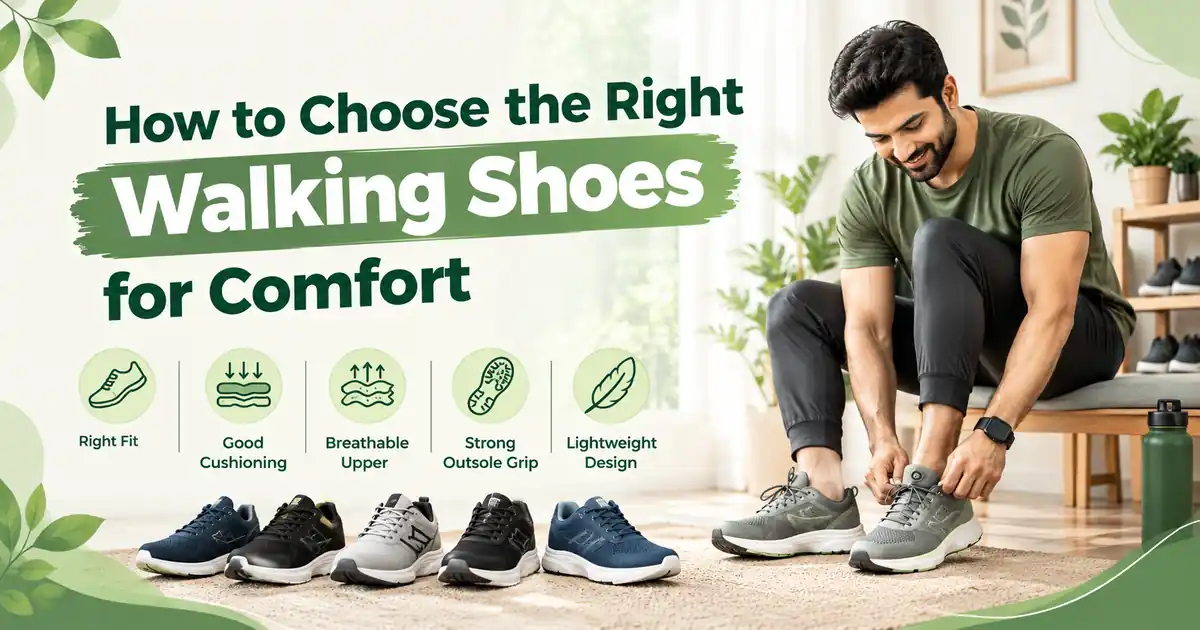
How to Choose Walking Shoes for Comfort and Support
Walking is one of the simplest ways to add more movement to your day. You might walk for exercise, commute to work, run errands, travel, walk after meals, or simply spend more time on your feet.
But if you plan to walk regularly, your footwear deserves some attention.
The right walking shoes don’t have to be the most expensive, the most heavily cushioned, or the most popular pair on the market. What matters is whether they fit your feet comfortably and suit the way, place, and amount of walking you actually do.
If you’re wondering how to choose walking shoes, start with the basics: fit, toe room, cushioning, support, stability, flexibility, breathability, traction, and durability.
This walking shoe buying guide will help you evaluate each factor so you can make a more informed decision before buying your next pair.
Table of Contents
- Why to Choose Walking Shoes?
- What Should You Look for in a Walking Shoe?
- Start With the Right Fit
- How Much Room Should Your Toes Have?
- Check the Toe Box
- Choose the Right Amount of Cushioning
- Look for Appropriate Support and Stability
- Consider Flexibility and Weight
- Don’t Ignore Breathability
- Check the Outsole and Grip
- Choose Shoes Based on Where You Walk
- Walking Shoes vs. Running Shoes
- How to Test Walking Shoes Before Buying
- How to Choose Walking Shoes Online
- Common Mistakes When Buying Walking Shoes
- How Often Should You Replace Walking Shoes?
- Quick Walking Shoe Buying Checklist
- Frequently Asked Questions
- Build Your Walking Habit
- Final Takeaway
Why to Choose Walking Shoes?
A comfortable pair of shoes can make regular walking easier to maintain.
On the other hand, shoes that pinch your toes, allow excessive heel movement, feel unstable, or don’t suit the surface you’re walking on can make every day walking less enjoyable.
There isn’t one walking shoe that is perfect for everyone.
Cleveland Clinic notes that footwear needs can vary depending on your lifestyle and the type of walking you’re doing. Someone taking short casual walks may want something different from someone doing longer fitness walks or hiking on uneven terrain.
That means choosing walking shoes isn’t simply about finding a shoe with the highest specifications.
It’s about finding the right combination of features for your feet and your routine.
And if you’re building a regular walking habit, comfortable footwear can become one less obstacle between you and your daily movement.
For more motivation to keep moving, explore the benefits of walking every day and see how regular walking can fit into an active lifestyle.
What Should You Look for in a Walking Shoe?
When comparing walking shoes, don’t focus on just one feature.
Instead, evaluate the entire shoe.
| Feature | What to Look For |
| Fit | Secure without feeling tight |
| Toe room | Enough space for natural toe movement |
| Cushioning | Comfortable for your preferred walking style |
| Support | Appropriate stability for your needs |
| Flexibility | Natural movement around the forefoot |
| Weight | Comfortable enough for extended use |
| Breathability | Suitable airflow for your environment |
| Grip | Traction appropriate for your walking surfaces |
| Durability | Construction suited to your frequency of use |
| Purpose | Designed appropriately for your main activity |
REI’s current walking-shoe guidance puts particular emphasis on fit, stability and cushioning, while also recommending that shoppers consider where they plan to walk. Road-running shoes, trail-running shoes and hiking footwear can all have a place depending on the environment.
So before asking, “Which walking shoe is best?”, ask:
“Which walking shoe is best for me?”
Start With the Right Fit
If you remember only one rule from this guide, make it this:
Fit comes first.
A shoe can have excellent cushioning, advanced materials, or impressive technology, but those features don’t compensate for a poor fit.
REI specifically describes fit as the most important consideration when choosing walking footwear. A good fit should feel secure without being tight, with enough room around the toes.
When trying on a walking shoe, pay attention to three main areas.
Heel
Your heel should feel secure.
Some movement can occur naturally, but your heel shouldn’t repeatedly slide up and down inside the shoe while walking.
Excessive movement can become irritating over longer walks.
Midfoot
The middle of the shoe should hold your foot comfortably.
It shouldn’t feel loose and unstable, but it also shouldn’t create uncomfortable pressure across the top of your foot.
Forefoot
The widest part of your foot should have enough room.
If your foot feels squeezed from the sides, consider trying a wider model or a different shoe shape.
Don’t rely on a “break-in” excuse
A common mistake is buying an uncomfortable shoe because you assume it will eventually become comfortable.
A little adjustment can be normal with footwear, but you shouldn’t have to tolerate obvious pressure, pain, or an excessively tight fit while waiting for the shoe to change.
Cleveland Clinic specifically advises against using “I’ll break them in” as an excuse for a tight fit.
How Much Room Should Your Toes Have?
Your toes need room to move.
A commonly recommended guideline is to have approximately one finger’s width of space between your longest toe and the end of the shoe. Both REI and Cleveland Clinic use this as a practical fitting guideline.
Don’t simply stand in the shoe and check the length.
Walk around.
Your foot shouldn’t feel like it’s being pushed forward into the front of the shoe.
Also remember that your longest toe isn’t necessarily your big toe. Check whichever toe extends the farthest.
Should you buy a larger size?
Not automatically.
A larger shoe isn’t necessarily a better shoe if it allows your foot to move excessively.
If your toes need more room but the heel is already slipping, you may need a different shoe shape or width rather than simply going up a size.
Check the Toe Box
The toe box is the front portion of the shoe where your toes sit.
A good toe box should provide enough room for your toes without allowing your foot to slide around.
A roomier toe box can be especially useful for people with:
- Wider feet
- Wider forefeet
- Bunions
- Higher-volume feet
- Feet that swell during long walks
- A preference for more toe movement
REI notes that people with wider forefeet, bunions, or feet that swell during longer walks may prefer a roomier toe box.
When trying on a shoe, stand normally and ask:
Can I move my toes comfortably?
If your toes are compressed together or repeatedly touch the front of the shoe, look for another size, width, or model.
Choose the Right Amount of Cushioning
Cushioning is important, but more cushioning isn’t automatically better.
Some walkers prefer a soft, plush feel underfoot. Others prefer a firmer and more responsive sensation.
REI’s current guidance notes that the appropriate amount of cushioning is largely a matter of personal preference, along with factors such as foot shape, walking style, comfort needs, and where you walk.
Consider your walking environment
Walking on concrete:
Comfortable cushioning may be desirable because concrete provides a firm surface.
Walking on pavement:
A comfortable road shoe or walking shoe can work well.
Indoor walking:
Breathability and comfort may become more important.
Uneven paths:
Stability and traction deserve more attention.
Long days on your feet:
Look for a combination of comfortable cushioning, secure fit, and appropriate stability.
Don’t choose cushioning based solely on marketing.
The shoe should actually feel comfortable to you.
Look for Appropriate Support and Stability
Support is another feature that can easily become confusing when shopping for shoes.
You don’t necessarily need the most structured shoe available.
Instead, look for a shoe that feels stable and secure during your normal walking movement.
REI recommends checking how easily a shoe bends and twists. A walking shoe should generally flex around the ball of the foot rather than folding unpredictably through the middle, and it should offer some resistance to twisting.
Try the bend test
Hold the shoe at the heel and toe and gently bend it.
Notice where it flexes.
A useful general sign is that the shoe flexes around the forefoot rather than collapsing through the middle of the shoe.
Try the twist test
Hold the heel and toe and gently twist the shoe.
You should feel some resistance.
If the shoe twists extremely easily, it may provide less lateral structure than you prefer.
These tests aren’t a complete assessment of a shoe, but they’re useful when comparing different models.
What about arch support?
Arch support needs vary from person to person.
Some people prefer a noticeable arch structure, while others find a more neutral design comfortable.
Don’t assume that maximum arch support is automatically better.
If you have ongoing foot pain or a diagnosed foot condition, consider speaking with an appropriate healthcare professional rather than relying entirely on shoe marketing.
Consider Flexibility and Weight
Walking requires repeated movement through the foot and ankle.
Your walking shoes should therefore provide enough flexibility for comfortable movement without feeling completely unstable.
A useful balance is:
Flexible where you need movement + structured where you need stability.
Weight is another consideration.
If you’re wearing your shoes for:
- Daily walks
- Commuting
- Travel
- Shopping
- Fitness walking
- Long periods of standing
a lighter shoe may feel more convenient over extended periods.
However, don’t sacrifice fit or comfort just to save weight.
A slightly heavier shoe that fits properly may be a much better choice than an ultra-light shoe that doesn’t suit your feet.
Don’t Ignore Breathability
Your feet can become warm and sweaty during longer walks, especially in hot or humid weather.
The upper material of a shoe can influence airflow, comfort, flexibility and durability. Cleveland Clinic specifically highlights the role of upper materials such as mesh, leather and synthetic fabrics in these characteristics.
Consider the environment
| Walking Situation | Feature to Prioritize |
| Hot weather | Breathability |
| Humid weather | Airflow + moisture management |
| Long indoor use | Breathability + comfort |
| Rainy conditions | Weather resistance |
| Daily commuting | Durability + comfort |
| Outdoor paths | Grip + stability |
| Travel | Comfort + versatility |
For warm conditions, breathable mesh may be attractive.
For wet conditions, greater weather resistance may be more useful.
The important thing is to match the material to your actual environment.
Check the Outsole and Grip
The outsole is the bottom part of the shoe that contacts the ground.
Its grip becomes particularly important when you’re walking on surfaces that may be wet, smooth, uneven, or loose.
Think about where you normally walk.
Mostly sidewalks and pavement?
A standard road-oriented outsole may be enough.
Parks and gravel paths?
You may want more traction and stability.
Wet or slippery surfaces?
Pay closer attention to the outsole pattern and traction characteristics.
RunRepeat’s current testing methodology includes dedicated traction measurements on wet concrete, illustrating why outsole grip can be an important consideration for certain walking environments.
You don’t necessarily need an aggressive trail outsole for everyday city walking.
Choose traction based on the surfaces you actually encounter.
Choose Shoes Based on Where You Walk
One of the easiest ways to narrow your choices is to identify your primary walking environment.
Walking for Exercise
If you walk specifically for fitness, choose a shoe that remains comfortable during repeated steps and longer sessions.
Road-running shoes can also be a good option for fitness walking on pavement.
In fact, REI recommends considering road-running shoes for brisk walking because they are designed for paved surfaces and can also provide versatility if you want to run occasionally.
Walking for Daily Commutes
Commuting can involve more than walking.
You might:
- Walk to a bus stop
- Stand on public transport
- Climb stairs
- Walk on pavement
- Spend hours at work
- Walk home
For this type of use, versatility may matter more than specialized performance.
Look for comfortable fit, durability, grip, breathability and a style that works with your normal clothing.
Walking and Standing All Day
If your routine involves many hours on your feet, comfort becomes particularly important.
Current walking-shoe testing from RunRepeat evaluates factors such as shock absorption, flexibility, durability, traction, breathability, fit and stability when assessing shoes for all-day use.
But remember that laboratory performance doesn’t determine whether a particular shoe will fit your feet.
Your individual fit still matters.
Walking While Traveling
Travel often means unexpected amounts of walking.
You may spend hours moving through airports, train stations, streets, shopping areas and tourist destinations.
A versatile shoe that combines:
- Comfortable fit
- Moderate cushioning
- Reliable grip
- Breathability
- Reasonable weight
can be more practical than carrying several specialized pairs.
Walking Shoes vs. Running Shoes: What’s the Difference?
You don’t necessarily need a shoe specifically labeled “walking shoe.”
Running shoes can also work very well for walking.
REI notes that road-running shoes can be suitable for brisk walking on pavement, while trail-running shoes and hiking shoes can be more appropriate for certain non-paved environments.
Walking shoes may emphasize:
- Everyday comfort
- Stable movement
- Moderate flexibility
- Comfortable cushioning
- Practical durability
Running shoes may emphasize:
- Cushioning
- Weight reduction
- Running-specific geometry
- Responsiveness
- Higher-impact movement
There is considerable overlap between the categories.
So don’t ask only:
“Is this officially a walking shoe?”
Ask:
“Does this shoe fit me and suit the way I walk?”
If you’re interested in understanding the broader differences between the activities, read our guide to walking vs. running.
How to Test Walking Shoes Before Buying
Don’t judge a walking shoe only by its appearance.
If possible, test it properly.
1. Wear your normal walking socks
The thickness of your socks can affect the fit.
2. Stand up
Check the length, width and toe room while standing.
3. Walk around
Take more than a few steps.
Walk long enough to notice whether your heel slips or any area begins to feel uncomfortable.
4. Check your toes
Make sure your toes aren’t touching the front of the shoe.
5. Check the heel
Your heel should feel secure without excessive pressure.
6. Bend your foot
Notice how naturally the shoe moves with your foot.
7. Try both shoes
Your feet may not be exactly the same size.
Always assess the fit of both shoes.
8. Pay attention to discomfort
If a shoe creates obvious pressure or pain during the fitting process, don’t convince yourself that you have to tolerate it.
Try another size, width, shape, or model.
How to Choose Walking Shoes Online
Buying walking shoes online is convenient, but you need to pay closer attention to sizing and fit information.
Before ordering, check:
- The manufacturer’s size chart.
- Available width options.
- Shoe measurements if provided.
- The intended use of the shoe.
- Cushioning and stability characteristics.
- Customer reviews for recurring fit issues.
- Return and exchange policies.
Don’t assume that the same size will fit identically across every brand.
If possible, measure your feet and compare the measurements with the manufacturer’s sizing information.
And always check the return policy before purchasing a pair you’re unfamiliar with.
Common Mistakes When Buying Walking Shoes
Mistake 1: Choosing style over fit
A good-looking shoe isn’t necessarily a comfortable walking shoe.
Mistake 2: Assuming your usual size always works
Sizing and shape can vary between brands and models.
Mistake 3: Choosing maximum cushioning automatically
More cushioning doesn’t automatically mean more comfort.
Mistake 4: Ignoring toe room
Your toes need sufficient space to move naturally.
Mistake 5: Buying a shoe that’s already too tight
Don’t depend on a long break-in period to fix an obviously uncomfortable fit.
Mistake 6: Ignoring your walking surface
A shoe designed for smooth pavement may not be the best option for rough or uneven paths.
Mistake 7: Buying the same shoe as someone else
A shoe that works perfectly for your friend may not suit your foot shape.
Mistake 8: Assuming expensive means better
Price isn’t a substitute for proper fit.
Mistake 9: Focusing on one feature
Excellent cushioning can’t compensate for a poor fit.
Neither can impressive traction, lightweight materials, or strong arch support.
Mistake 10: Ignoring signs of wear
Even good footwear eventually needs to be replaced.
How Often Should You Replace Walking Shoes?
There isn’t a universal replacement date for every walking shoe.
How long a pair lasts depends on:
- How frequently you wear it
- How far you walk
- Walking surfaces
- Shoe construction
- Materials
- Your individual usage
Instead of relying only on a calendar, inspect the shoes regularly.
Look for:
- Significant outsole wear
- Uneven wear patterns
- Damaged upper material
- Loss of cushioning
- Changes in stability
- Persistent discomfort that wasn’t there previously
A shoe doesn’t necessarily become unsuitable simply because it reaches a certain age.
Its condition and your experience while wearing it are more useful indicators.
Quick Walking Shoe Buying Checklist
Before buying your next pair, run through this checklist.
Fit
- Does the heel feel secure?
- Is the midfoot comfortably snug?
- Do my toes have enough room?
- Is the shoe wide enough?
- Does the shoe feel comfortable on both feet?
Cushioning
- Do I like the cushioning level?
- Does it feel comfortable after several minutes?
- Does it suit my usual walking surface?
Support and stability
- Does the shoe feel stable?
- Does it provide enough structure for my needs?
- Does it bend naturally?
- Does it resist excessive twisting?
Breathability
- Will I use it in hot weather?
- Do my feet tend to become warm or sweaty?
- Is the upper material appropriate for my environment?
Grip
- What surfaces do I normally walk on?
- Will I encounter wet pavement?
- Do I need additional traction?
Purpose
- Is it mainly for exercise?
- Daily commuting?
- Long walks?
- Travel?
- Standing and walking all day?
- Mixed surfaces?
Buying decision
- Is the size correct?
- Is the width appropriate?
- Is the return policy reasonable?
- Does the shoe actually feel comfortable?
If you can answer these questions confidently, you’ve already eliminated many of the common mistakes people make when buying walking shoes.
Frequently Asked Questions
How should walking shoes fit?
Walking shoes should feel secure without being tight. The heel and midfoot should remain comfortably supported while the toes have enough room to move. REI recommends approximately a finger’s width between your longest toe and the front of the shoe.
How much space should be in the toe box?
You should have enough room for your toes to move without touching the front of the shoe. A finger’s width between the longest toe and the end of the shoe is a useful general guideline.
Are cushioned shoes better for walking?
Not necessarily. The ideal cushioning level depends on personal preference, walking style, foot shape and walking environment. Some people prefer softer cushioning, while others prefer a firmer feel.
Should walking shoes have arch support?
Arch-support preferences vary. Some people find structured arch support comfortable, while others prefer a neutral design. Choose based on your individual comfort rather than assuming more support is always better.
Are walking shoes better than running shoes for walking?
Not necessarily. Running shoes can be excellent walking shoes, particularly for pavement and fitness walking. REI specifically recommends road-running shoes as an option for brisk walking.
What are the best shoes for walking all day?
There is no single best shoe for everyone. For all-day use, prioritize proper fit, comfortable cushioning, appropriate stability, breathability and durability. Your foot shape and walking environment should guide the final decision.
How do I choose walking shoes for wide feet?
Look for shoes available in wider widths or models with a roomier toe box. The shoe should provide enough space across the forefoot without allowing excessive movement inside the shoe.
Can I use running shoes for walking?
Yes. Many running shoes can work very well for walking. They may be particularly useful if you want one pair that can handle both walking and occasional running.
How often should walking shoes be replaced?
Replace them when their condition or performance has noticeably declined. Look for significant outsole wear, damaged materials, reduced cushioning, reduced stability, or new discomfort rather than relying on one universal replacement schedule.
Build Your Walking Habit
Finding the right walking shoes is only part of the equation.
The bigger goal is to make walking a habit you can maintain.
If you already have a pair that fits comfortably, put them to use.
Build Your 30-Day Better Living Routine
You’ve got the right shoes. Now build a walking habit you can actually maintain.
Download the 30-Day Better Living Planner from InfuseUrLife and use it to track your walks, daily steps, workouts, movement, and healthy habits.
[Download the 30-Day Better Living Planner]
If you’re looking for a structured starting point, try our 30 Days walking challenge and gradually build your walking routine.
Small actions. Consistent effort. A better routine.
Live better. Live smarter. Every day.
Final Takeaway
Learning how to choose walking shoes doesn’t have to be complicated.
Start with fit.
Make sure your heel feels secure, your midfoot is comfortably supported, and your toes have enough room.
Then consider cushioning, stability, flexibility, weight, breathability, traction and durability based on how and where you walk.
If you’re mostly walking on city pavement, you may prioritize comfort and a lightweight design. If you spend more time on uneven paths, stability and traction may deserve greater attention. If you’re on your feet all day, comfort and fit become even more important.
And remember:
The best walking shoe isn’t necessarily the most expensive, most cushioned, or most popular shoe.
It’s the one that fits your feet comfortably and suits your actual walking routine.
Once you’ve found that pair, don’t overthink it.
Put them on and start walking.
Tags:
How to choose walking shoes, Best walking shoes for daily walking, Walking shoes for beginners, Best shoes for walking, How to choose the right walking shoes, Comfortable walking shoes, Walking shoe buying guide, Walking shoes for everyday use, Walking shoes for long walks, Walking shoes for daily use, Flexible walking shoes, Durable walking shoes, Walking shoe fit, etc.
References:
https://health.clevelandclinic.org/how-to-find-the-best-walking-shoes
https://www.rei.com/learn/expert-advice/walking-shoes
https://www.runrepeat.com/guides/best-all-day-wear-walking-shoes