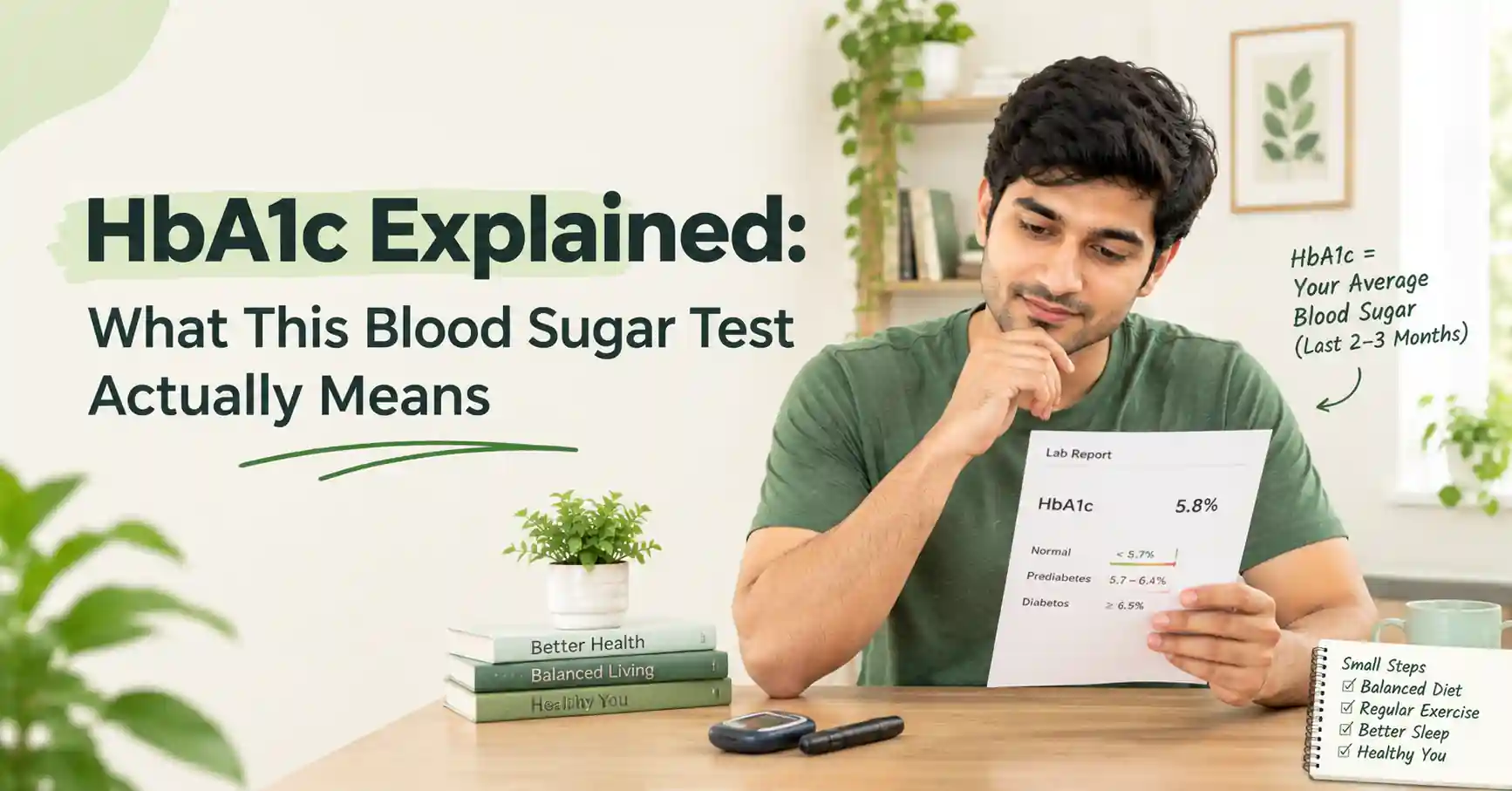
HbA1c Explained: What This Blood Sugar Test Actually Means?
You may have seen HbA1c written on a blood-test report and wondered what the percentage actually means.
Is 5.6% normal? Is 6.1% diabetes? What about 6.8%? And if your result is already in the diabetes range, what number should you aim for?
These questions are common because HbA1c is different from the blood sugar number you may see on a glucose meter. Instead of showing your blood glucose at one particular moment, HbA1c gives a picture of your average blood glucose over roughly the previous two to three months.
That makes it a useful test for screening, diagnosing type 2 diabetes and prediabetes, and monitoring diabetes.
But one HbA1c number does not tell the entire story.
Your result needs to be considered alongside your health history, symptoms, other blood-glucose tests, medications and, in some situations, conditions that can affect the accuracy of the test.
In this Blog Post, we’ll break down HbA1c in simple language, explain the commonly used ranges, discuss what you should aim for, and look at what can affect your result.
Disclaimer: This Blog Post is for general educational purposes and is not a substitute for medical diagnosis or individualized treatment. Do not start, stop or change diabetes medication based solely on information in this Blog Post. Discuss your HbA1c result and personal target with a qualified healthcare professional.
Table of Contents
- What Is HbA1c?
- What Does HbA1c Actually Measure?
- Why Does HbA1c Represent About Three Months?
- What Are the Normal, Prediabetes and Diabetes HbA1c Ranges?
- What Should You Aim For?
- Does HbA1c Require Fasting?
- How Is the HbA1c Test Done?
- What Does Your HbA1c Number Mean?
- Can HbA1c Be Different From Your Daily Blood Sugar Readings?
- What Can Affect an HbA1c Result?
- HbA1c and Prediabetes
- Can Lifestyle Changes Help Lower HbA1c?
- How Often Should HbA1c Be Checked?
- When Should You Talk to a Healthcare Professional?
- Frequently Asked Questions
- Download the 30-Day Better Living Planner
- Final Takeaway
What Is HbA1c?
HbA1c stands for glycated hemoglobin A1c.
It is a blood test that measures the percentage of hemoglobin in your red blood cells that has glucose attached to it.
Hemoglobin is a protein inside red blood cells that carries oxygen around your body.
When glucose is present in your bloodstream, some of it naturally attaches to hemoglobin. The higher your average blood glucose has been, the greater the amount of glucose attached to hemoglobin tends to be.
The HbA1c test measures this percentage.
Because red blood cells typically live for around three months, HbA1c provides information about your average blood glucose over approximately the previous two to three months.
This is why HbA1c is sometimes described as a longer-term blood sugar test.
What Does HbA1c Actually Measure?
Imagine checking your blood sugar with a glucose meter.
You might get a result such as:
108 mg/dL
That number tells you what your blood glucose was around the time you tested it.
But blood glucose naturally changes throughout the day.
It can rise after eating and change with physical activity, stress, illness, medication and other factors.
HbA1c works differently.
Instead of asking:
“What is my blood sugar right now?”
it gives you a broader picture:
“What has my average blood glucose generally looked like over the last few months?”
The American Diabetes Association describes HbA1c as a longer-term view that complements day-to-day glucose monitoring.
That is one reason doctors use both HbA1c and, when appropriate, direct blood-glucose measurements.
Why Does HbA1c Represent About Three Months?
The reason comes down to your red blood cells.
Glucose circulating in your blood attaches to hemoglobin inside red blood cells. Since red blood cells remain in circulation for roughly three months, measuring glycated hemoglobin provides an indication of blood glucose exposure over that period.
However, it is important not to interpret HbA1c as a perfectly even three-month average.
Recent weeks can have a meaningful influence on the result, and your HbA1c is still an estimate of your overall glucose exposure rather than a detailed record of every glucose rise and fall.
So if you’ve recently made lifestyle changes, one HbA1c test may not immediately show the full effect of those changes.
What Are the Normal, Prediabetes and Diabetes HbA1c Ranges?
When HbA1c is being used for diagnosing or screening for diabetes and prediabetes, commonly used thresholds are:
| HbA1c Result | General Interpretation |
| Below 5.7% | Normal range |
| 5.7%–6.4% | Prediabetes |
| 6.5% or higher | Diabetes range |
These thresholds are used by major medical organizations, including the American Diabetes Association and MedlinePlus.
But there is an important qualification.
A diagnostic threshold is not the same thing as an individual treatment target.
For example, a person living with diabetes may have a personalized HbA1c target based on their age, overall health, duration of diabetes, complications, risk of low blood sugar and other factors.
What Should You Aim For?
This depends on why you’re having the HbA1c test.
If you do not have diabetes
For diagnosis, an HbA1c below 5.7% is generally considered within the normal range.
An HbA1c between 5.7% and 6.4% falls into the commonly used prediabetes range.
An HbA1c of 6.5% or higher is in the diabetes range and generally requires appropriate medical evaluation and, in people without symptoms, confirmation according to the applicable diagnostic guidance.
If you have diabetes
The target is different.
The American Diabetes Association states that an HbA1c of less than 7% is a common goal for many nonpregnant adults with diabetes, but the appropriate target can vary from person to person.
Your healthcare professional may therefore recommend a target that is:
- Lower than 7%
- Around 7%
- Higher than 7%
depending on your individual circumstances.
So don’t compare your HbA1c target with someone else’s and assume yours should be identical.
Your target should be individualized.
Does HbA1c Require Fasting?
Usually, no.
One advantage of HbA1c testing is that you generally do not need to fast before the test. MedlinePlus and Healthdirect both state that no special preparation is normally required for an HbA1c test.
However, there is an important practical detail.
If your doctor has ordered HbA1c along with other blood tests, you may still be asked to fast because one of those other tests could require fasting.
So always follow the instructions given by your healthcare provider or laboratory.
How Is the HbA1c Test Done?
HbA1c is a relatively simple blood test.
A healthcare professional may collect blood from a vein in your arm, and some settings can also use a finger-prick method.
The sample is then analyzed to determine the percentage of glycated hemoglobin.
The test itself generally takes only a short time.
Like most blood tests, you may experience a brief sting or minor bruising at the collection site.
What Does Your HbA1c Number Mean?
Let’s look at some examples.
HbA1c of 5.2%
This falls below the commonly used 5.7% threshold for prediabetes.
That does not mean that you should ignore your overall health, but the result is not in the usual prediabetes or diabetes diagnostic range.
HbA1c of 5.9%
This falls within the commonly used prediabetes range.
It does not mean that you have diabetes.
Instead, it indicates that your average blood glucose has been higher than the normal range and that your risk of developing type 2 diabetes may be increased.
This is an appropriate point to discuss your result with your healthcare professional and review lifestyle and risk factors.
You can also read our comprehensive guide to prediabetes for a broader explanation of the condition.
HbA1c of 6.4%
This is still below the 6.5% diagnostic threshold for diabetes but is at the upper end of the commonly used prediabetes range.
It deserves appropriate follow-up rather than panic.
HbA1c of 6.7%
An HbA1c of 6.5% or higher falls within the diabetes diagnostic range.
However, diagnosis is not something you should make from a Blog Post or from a single number without appropriate clinical context.
If you receive a result in this range and have not previously been diagnosed with diabetes, speak with your healthcare professional about confirmation and next steps. Diagnostic guidance commonly recommends confirmation in people without classic symptoms.
HbA1c of 8%
If you already have diabetes, an HbA1c of 8% is above the commonly used target of less than 7% for many nonpregnant adults.
That does not mean that you have “failed.”
It means your healthcare team may want to review your current diabetes-management plan.
The appropriate response could involve reviewing food habits, physical activity, medication, glucose monitoring and other factors.
Do not change medication doses on your own.
Can HbA1c Be Different From Your Daily Blood Sugar Readings?
Yes.
Your HbA1c is a longer-term measure, while a glucose meter or continuous glucose monitor provides more immediate information.
For example, you might occasionally see a normal glucose reading after waking up while still having a higher HbA1c.
Why?
Because a single reading represents one moment.
Your HbA1c reflects glucose exposure over a much longer period.
Similarly, two people can have the same HbA1c while having different patterns of blood glucose throughout the day.
This is why healthcare professionals may use HbA1c alongside other glucose measurements when appropriate.
What Can Affect an HbA1c Result?
HbA1c is useful, but it is not perfect for every person or every situation.
Certain conditions can affect the accuracy or interpretation of the result.
These can include:
- Some types of anemia
- Iron deficiency
- Certain blood disorders
- Kidney disease
- Liver disease
- Pregnancy
- Conditions affecting red blood cells
- Certain medications
- Recent blood transfusion in some circumstances
MedlinePlus and Healthdirect both note that conditions affecting red blood cells and certain other health conditions can make HbA1c less reliable.
This is why you should tell your healthcare professional about relevant medical conditions and medications when discussing an HbA1c result.
If your HbA1c seems inconsistent with your glucose readings or clinical situation, your healthcare professional may consider additional testing.
HbA1c and Prediabetes
Prediabetes means your blood glucose is higher than the normal range but not high enough to meet the commonly used diagnostic threshold for diabetes.
Using HbA1c:
5.7%–6.4% = commonly used prediabetes range
Prediabetes does not mean that you definitely will develop type 2 diabetes.
It means your risk is higher and that this is an important opportunity to review your health habits and risk factors.
Diabetes UK similarly describes HbA1c in the range of 42–47 mmol/mol as indicating increased risk of developing type 2 diabetes.
This is where sustainable lifestyle changes can matter.
Rather than attempting an extreme diet for two weeks, focus on habits you can maintain.
Can Lifestyle Changes Help Lower HbA1c?
Lifestyle changes can be an important part of blood-glucose management, particularly for people with prediabetes or type 2 diabetes.
Useful areas to discuss with your healthcare professional include:
1. Build balanced meals
Prioritize a varied eating pattern that includes vegetables, fruits, whole grains, pulses, protein sources and other nutrient-dense foods appropriate for your needs.
Our healthy eating guide for weight loss can provide additional practical context around building sustainable eating habits.
2. Increase regular physical activity
Walking, cycling, swimming, resistance training and other activities can contribute to overall health and glucose management.
You don’t need to begin with an extreme workout.
Consistency matters.
Our 30-days walking challenge can help you think about walking as a regular daily habit rather than something you do only when you have time for a formal workout.
3. Pay attention to portions
Even nutritious foods can contribute substantial energy when portions become very large.
Instead of eliminating entire food groups without medical advice, focus on a balanced eating pattern that you can realistically maintain.
4. Reduce highly processed choices when they dominate your diet
Foods high in added sugars, refined carbohydrates, saturated fat or sodium may deserve attention depending on your overall eating pattern.
The goal isn’t to label individual foods as “good” or “bad.”
It’s about what you eat most of the time.
5. Work on consistency
A healthy routine that you follow for months is generally more useful than an extreme routine that lasts for a week.
If maintaining exercise is difficult, read our guide on how to stay consistent with exercise.
How Often Should HbA1c Be Checked?
The appropriate testing frequency depends on why you are being tested and your individual situation.
For people with diabetes, HbA1c is commonly checked periodically to assess glucose management.
The ADA notes that people living with diabetes generally have HbA1c checked at least twice a year, with more frequent testing sometimes appropriate when treatment has changed or glucose management is not at the desired level.
If you have prediabetes or other risk factors, your healthcare professional may recommend periodic testing as well.
The important point is:
Don’t choose your testing schedule solely from an online article.
Your healthcare professional can determine how frequently you need testing based on your health and previous results.
HbA1c Is Not the Same as a Blood Sugar Reading
It is easy to confuse these two.
Blood glucose test
Shows your blood glucose at a particular point in time.
HbA1c
Shows a longer-term picture of average blood glucose over approximately two to three months.
Think of it this way:
Blood glucose = photograph
HbA1c = longer-term summary
Neither replaces the other in every situation.
If you’re monitoring diabetes, your healthcare team may use both depending on your treatment plan.
What Should You Aim For?
If you’ve received an HbA1c report, don’t immediately ask:
“Is this number good or bad?”
Instead ask:
1. Why was I tested?
Was it routine screening, suspected prediabetes, diabetes diagnosis or diabetes monitoring?
2. Which range does my result fall into?
Is it below 5.7%, between 5.7% and 6.4%, or 6.5% or higher?
3. Does this result need confirmation?
A diabetes-range result does not always mean you should immediately conclude that you have diabetes, particularly if you have no symptoms. Appropriate diagnostic confirmation may be needed.
4. What is my personal target?
If you already have diabetes, ask your healthcare team what HbA1c target is appropriate for you.
5. What should I change?
If your HbA1c is above your target, discuss the next step rather than attempting drastic changes on your own.
When Should You Talk to a Healthcare Professional?
Discuss your HbA1c result with a healthcare professional if:
- Your HbA1c is in the prediabetes range.
- Your HbA1c is 6.5% or higher and you have not been diagnosed with diabetes.
- Your HbA1c is above your diabetes-management target.
- Your HbA1c does not seem to match your glucose readings.
- You have anemia or another blood disorder.
- You have kidney or liver disease.
- You are pregnant.
- You take medications that may affect glucose or HbA1c.
- You have symptoms of high blood glucose.
Symptoms that can occur with high blood glucose include increased thirst, frequent urination, unexplained weight loss, increased hunger, fatigue and blurred vision.
If you have concerning or severe symptoms, seek appropriate medical care rather than relying on an online explanation of your HbA1c.
Frequently Asked Questions
What is a normal HbA1c?
For diagnostic purposes, an HbA1c below 5.7% is generally considered within the normal range.
However, your healthcare professional may interpret your result alongside other risk factors and tests.
Is HbA1c of 6.0% diabetes?
No. An HbA1c of 6.0% falls within the commonly used prediabetes range, which is 5.7%–6.4%.
It is not the same as a diabetes diagnosis.
Is HbA1c of 6.5% diabetes?
An HbA1c of 6.5% or higher is in the diabetes diagnostic range. However, if you do not have classic symptoms, your healthcare professional may need to confirm the result before making a diagnosis.
Does HbA1c require fasting?
Generally, no. HbA1c testing normally does not require fasting. However, other blood tests performed at the same appointment may require fasting.
What HbA1c should a person with diabetes aim for?
For many nonpregnant adults with diabetes, the ADA recommends an HbA1c target of less than 7%. However, individual targets may differ depending on age, health status, complications and other factors.
Can HbA1c be wrong?
HbA1c can be less reliable in certain situations, including some forms of anemia, blood disorders, kidney disease, liver disease and pregnancy. Your healthcare professional can determine whether another test is needed.
Can exercise lower HbA1c?
Regular physical activity can be part of a healthy approach to blood-glucose management, but the effect varies between individuals. Exercise should be considered alongside eating habits, medication when prescribed, sleep and other aspects of diabetes care.
Is prediabetes the same as diabetes?
No.
Prediabetes means blood glucose is higher than the normal range but below the commonly used diabetes threshold. It indicates increased risk and is an opportunity to address modifiable risk factors.
Download the 30-Day Better Living Planner
Understanding your HbA1c is only the first step.
If you’ve been advised to improve your eating habits, physical activity or daily routine, avoid trying to change everything overnight.
Use the 30-Day Better Living Planner to organize your meals, movement, daily habits and progress one day at a time.
Small, repeatable habits can be easier to maintain than an extreme short-term plan.
Download the 30-Day Better Living Planner
Final Takeaway
HbA1c is a longer-term blood sugar test that gives you a picture of your average blood glucose over roughly the previous two to three months.
For diagnostic purposes, the commonly used ranges are:
- Below 5.7%: normal range
- 5.7%–6.4%: prediabetes
- 6.5% or higher: diabetes range
But these numbers should not be treated as a complete diagnosis or as a universal personal target.
If you already have diabetes, a commonly recommended target for many nonpregnant adults is less than 7%, but your healthcare professional may set a different goal based on your individual circumstances.
The most useful way to look at HbA1c is not simply:
“Is my number good or bad?”
Instead ask:
“What does this number mean in my situation, and what should I do next?”
Understanding your result, following up when necessary, and building sustainable habits around food, physical activity and medical care can help you make informed decisions about your health.
References:
Hemoglobin A1C (HbA1c) Test
Diabetes Tests
HbA1c Test
Estimated Average Glucose (eAG)