15 Best Bodyweight Exercises for Beginners to Do at Home (No Equipment)
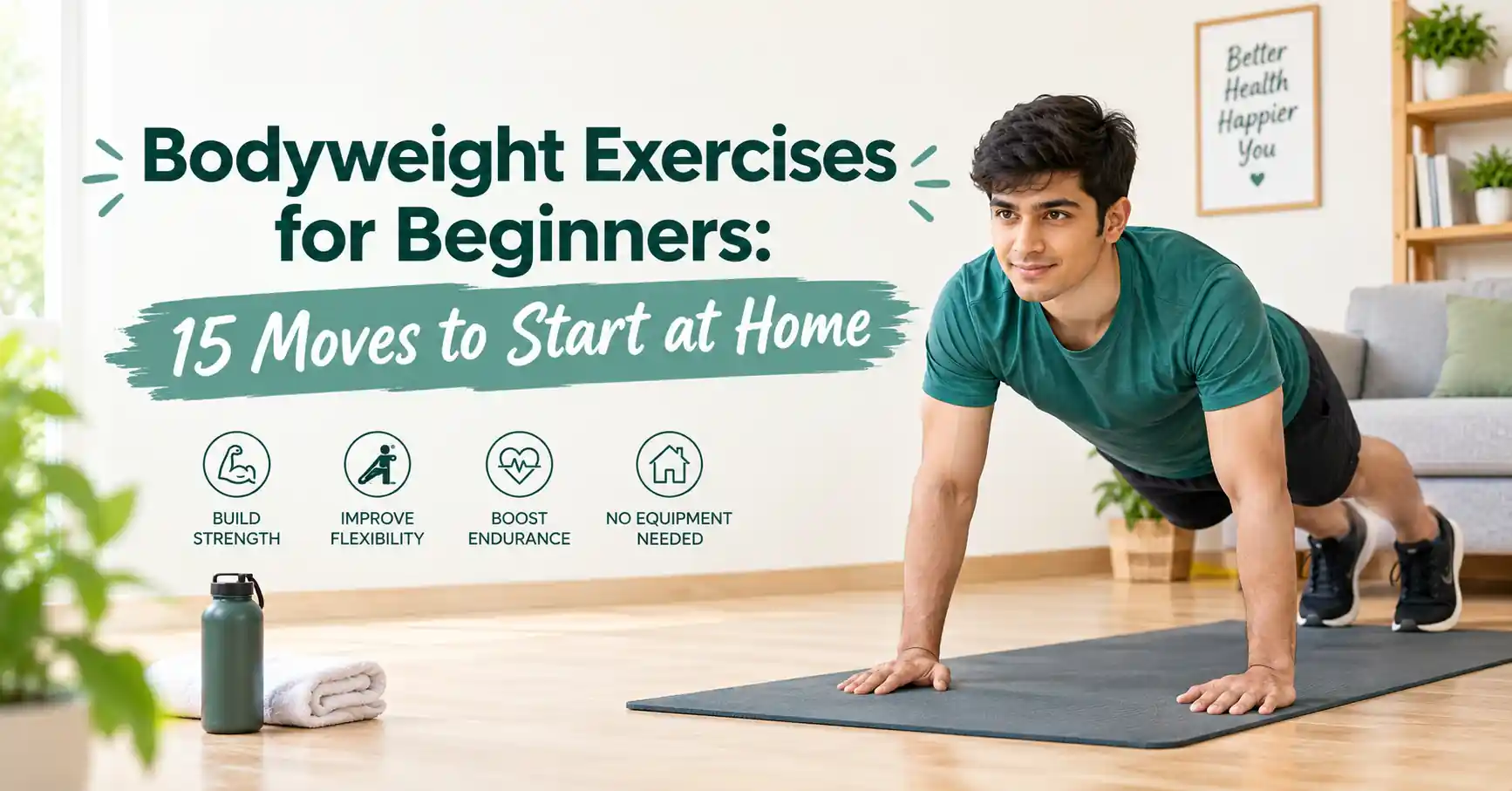
You don’t need a gym membership, expensive equipment or a complicated workout plan to start getting stronger. Bodyweight exercises for beginners can give you a practical way to start exercising at home using your own body as resistance.
The challenge for beginners isn’t usually finding exercises. There are hundreds of movements available online. The harder part is knowing which exercises to start with, how to perform them correctly, how many repetitions to do and how to turn them into a workout you can actually maintain.
That’s what this guide is designed to help you do.
You’ll learn 15 beginner-friendly bodyweight exercises, how to modify them when necessary, how to combine them into a simple full-body workout and how to progress as the movements become easier.
Important: This Blog Post provides general fitness information, not individualized medical advice. If you have a medical condition, recent injury, significant pain or specific exercise restrictions, speak with an appropriate healthcare professional before starting a new exercise program.
Table of Contents
- Why Start With Bodyweight Exercises?
- How to Choose Bodyweight Exercises as a Beginner
- 15 Bodyweight Exercises for Beginners
- Beginner Bodyweight Workout Circuit
- How Many Sets and Reps Should Beginners Do?
- How Often Should Beginners Do Bodyweight Exercises?
- How to Progress Your Bodyweight Workout
- Common Bodyweight Exercise Technique Mistakes
- Bodyweight Workout Safety Tips
- Frequently Asked Questions
- Build Your 30-Day Better Living Routine
- Final Takeaway
Why Start With Bodyweight Exercises?
One of the biggest advantages of bodyweight training is simplicity.
You can perform many exercises with little or no equipment, which makes them convenient for a home workout, a small room or even a short exercise break during a busy day.
More importantly, bodyweight training allows beginners to learn fundamental movement patterns before adding more resistance.
You can practice movements such as:
- Squatting
- Lunging
- Pushing
- Hip hinging
- Bracing your core
- Balancing
- Moving through a controlled range of motion
You don’t need to make your first workout extremely difficult.
A better approach is to choose movements that match your current ability and gradually make them more challenging.
Bodyweight exercises can also be part of a broader fitness routine. You can combine strength-focused sessions with activities such as walking, cycling or other forms of movement you enjoy.
For adults, general physical-activity guidelines recommend muscle-strengthening activities at least two days per week, alongside regular aerobic activity. Bodyweight movements such as push-ups are one example of muscle-strengthening exercise.
If you’re new to exercise, start gradually and build from there.
How to Choose Bodyweight Exercises as a Beginner
Instead of randomly selecting exercises, think about the movement pattern each exercise trains.
A balanced beginner workout can include:
Squatting
Squatting movements train the lower body and teach you how to bend and straighten your knees and hips under control.
Pushing
Push-up variations train pushing muscles in the chest, shoulders and arms.
Hip hinging
Hip-hinge movements teach you to move from the hips while maintaining control of your torso.
Single-leg movements
Lunges and step-ups introduce unilateral movement and can challenge balance and coordination.
Core stability
Exercises such as bird dogs and dead bugs teach you to control your trunk while your arms or legs move.
Full-body movement
Movements such as modified burpees combine several movement patterns and can be added once you are comfortable with simpler exercises.
The goal isn’t to perform the most advanced exercise.
The goal is to select movements you can perform safely, consistently and with reasonable control.
15 Bodyweight Exercises for Beginners
Here are 15 beginner-friendly exercises you can use to build a simple full-body routine.
1. Bodyweight Squat
Targets: Quadriceps, glutes, hamstrings and core
The bodyweight squat is one of the most useful movements for beginners because it teaches a basic lower-body movement pattern.
How to perform it:
- Stand with your feet approximately shoulder-width apart.
- Keep your chest comfortably upright.
- Brace your core gently.
- Push your hips back and bend your knees.
- Lower as far as you can while maintaining control.
- Push through your feet to return to standing.
Beginner modification: Use a chair behind you as a target. Lower toward the chair and stand back up without dropping onto it.
Technique cue: Keep your knees generally tracking in the same direction as your toes.
2. Wall Push-Up
Targets: Chest, shoulders and triceps
A wall push-up is an easy way to learn the pushing pattern before progressing toward floor push-ups.
How to perform it:
- Stand facing a wall.
- Place your hands on the wall around chest height.
- Step your feet back slightly.
- Keep your body in a straight line.
- Bend your elbows and bring your chest toward the wall.
- Push through your hands to return.
Beginner modification: Stand closer to the wall.
Progression: Move from wall push-ups to incline push-ups using a stable elevated surface.
3. Glute Bridge
Targets: Glutes, hamstrings and core
The glute bridge is performed on the floor and requires no equipment.
How to perform it:
- Lie on your back.
- Bend your knees and place your feet flat on the floor.
- Keep your arms relaxed beside you.
- Brace your core gently.
- Press through your feet.
- Lift your hips.
- Pause briefly at the top.
- Lower under control.
Technique cue: Think about lifting your hips rather than excessively arching your lower back.
4. Reverse Lunge
Targets: Legs and glutes
Reverse lunges can be easier to control than some forward-lunge variations because you step backward rather than forward.
How to perform it:
- Stand tall with your feet comfortable apart.
- Step one foot backward.
- Bend both knees while lowering your body.
- Keep your front foot stable.
- Push through the front foot to return to standing.
- Repeat on the other side.
Beginner modification: Hold a wall or sturdy support for balance.
Technique cue: Use a range of motion you can control instead of trying to reach the floor.
5. Bird Dog
Targets: Core, hips and stability
The bird dog teaches you to stabilize your torso while moving your limbs.
How to perform it:
- Start on your hands and knees.
- Keep your back in a comfortable neutral position.
- Extend one arm and the opposite leg.
- Pause briefly.
- Return to the starting position.
- Switch sides.
Beginner modification: Move only one limb at a time.
Technique cue: Try not to rotate your hips or torso as you extend your arm and leg.
6. Dead Bug
Targets: Core
The dead bug is another useful beginner core exercise.
How to perform it:
- Lie on your back.
- Bring your arms upward.
- Bend your knees so your legs are lifted.
- Brace your core gently.
- Slowly lower one arm and the opposite leg.
- Return to the starting position.
- Repeat on the other side.
Beginner modification: Move only your arms or only your legs.
Technique cue: Use slow movements rather than trying to complete repetitions quickly.
7. Forearm Plank
Targets: Core, shoulders and trunk stability
How to perform it:
- Start on your forearms and knees.
- Extend your legs behind you if you’re comfortable.
- Keep your body aligned.
- Brace your core.
- Hold the position while breathing normally.
Beginner modification: Keep your knees on the floor.
Don’t worry about holding a plank for a long time. A shorter, controlled hold is more useful than allowing your technique to break down.
8. Calf Raise
Targets: Calves
Calf raises are simple and require very little space.
How to perform it:
- Stand upright.
- Hold a stable surface if you need balance.
- Slowly raise your heels.
- Pause briefly at the top.
- Lower your heels under control.
Beginner modification: Use both legs and hold support.
Progression: Increase repetitions or eventually perform the movement with greater resistance or one leg when appropriate.
9. Hip Hinge
Targets: Glutes, hamstrings and posterior chain
The hip hinge is a movement pattern worth learning before attempting more advanced exercises such as Romanian deadlifts.
How to perform it:
- Stand with your feet comfortably apart.
- Keep your knees slightly bent.
- Push your hips backward.
- Keep your torso controlled.
- Stop when you feel an appropriate stretch through the back of your legs.
- Drive your hips forward to stand.
Beginner modification: Stand facing a wall and practice pushing your hips backward toward it.
Technique cue: Think “hips back”, not simply “bend forward.”
10. Step-Up
Targets: Legs and glutes
Use a stable, low step or platform.
How to perform it:
- Stand in front of the step.
- Place one foot firmly on it.
- Push through that foot to step up.
- Bring the other foot up.
- Step down under control.
- Repeat and switch sides.
Beginner modification: Use a lower step.
Make sure the surface is stable before beginning.
11. Incline Push-Up
Targets: Chest, shoulders and triceps
Once wall push-ups become comfortable, you can increase the challenge by using a stable elevated surface.
How to perform it:
- Place your hands on a stable elevated surface.
- Walk your feet backward.
- Keep your body aligned.
- Bend your elbows.
- Lower your chest toward the surface.
- Push back up.
Progression: Gradually use a lower surface as your strength improves.
12. Side-Lying Leg Raise
Targets: Hip and outer-leg muscles
How to perform it:
- Lie on your side.
- Keep your legs extended.
- Support your head comfortably.
- Lift the top leg slowly.
- Pause briefly.
- Lower it with control.
Technique cue: Keep your hips stacked rather than rolling backward.
13. Superman
Targets: Back and posterior chain
This exercise should be performed through a comfortable range of motion.
How to perform it:
- Lie face down.
- Extend your arms forward.
- Gently lift your arms and legs.
- Pause briefly.
- Lower them slowly.
Beginner modification: Lift only your arms or only your legs.
Avoid forcing a large range of motion.
14. Mountain Climber
Targets: Core, shoulders and whole-body conditioning
How to perform it:
- Start in a high-plank position.
- Keep your hands under or near your shoulders.
- Bring one knee toward your chest.
- Return it.
- Bring the opposite knee forward.
- Continue at a controlled pace.
Beginner modification: Slow the movement down and perform one knee at a time.
You don’t need to turn mountain climbers into a race.
15. Modified Burpee
Targets: Full body
A modified burpee can introduce a more dynamic full-body movement without requiring the jumping portion of a traditional burpee.
How to perform it:
- Stand tall.
- Bend down and place your hands on a stable surface or the floor.
- Step one foot back.
- Step the other foot back.
- Step your feet forward again.
- Stand tall.
Beginner modification: Keep the movement slow and remove the jump completely.
Focus on smooth transitions rather than speed.
Beginner Bodyweight Workout Circuit
You don’t need to perform all 15 exercises in a single session.
For your first few workouts, use this simple circuit:
| Exercise | Starting Point |
| Bodyweight squat | 10 reps |
| Wall or incline push-up | 8–10 reps |
| Glute bridge | 12 reps |
| Reverse lunge | 6–8 each side |
| Bird dog | 8 each side |
| Calf raise | 12–15 reps |
| Dead bug | 8 each side |
| Modified burpee | 5–8 reps |
Start with 1–2 rounds.
Rest as needed between exercises. A beginner doesn’t need to rush through the circuit.
Focus on completing every movement with controlled technique.
As you become more comfortable, you can gradually increase repetitions, add another round or progress individual exercises.
This approach is more sustainable than trying to make your first workout extremely difficult.
If you’re looking for a more structured routine to put these exercises into practice, explore the home workout for beginners guide for additional ideas to build a consistent home workout.
How Many Sets and Reps Should Beginners Do?
There isn’t one perfect number for everyone.
As a general starting point, many beginners can use approximately 8–12 repetitions for strength-focused movements, while simpler exercises such as calf raises or glute bridges may work well with somewhat higher repetitions.
For exercises based on time, such as planks, start with a short hold that you can maintain with good technique.
A practical beginner structure is:
- 1–2 sets initially
- 8–12 reps for many movements
- 10–15 reps for some simpler exercises
- Short, controlled holds for plank variations
- Enough rest to maintain good technique
The important thing is not to chase a specific number at the expense of form.
The CDC’s muscle-strengthening guidance uses 8–12 repetitions as a general reference and notes that one set can be useful, while two or three sets can provide additional benefit.
How Often Should Beginners Do Bodyweight Exercises?
For many beginners, two full-body strength sessions per week are a practical starting point.
For example:
| Day | Activity |
| Monday | Bodyweight workout |
| Tuesday | Walking or light movement |
| Wednesday | Rest or mobility |
| Thursday | Bodyweight workout |
| Friday | Walking or light movement |
| Saturday | Optional easy activity |
| Sunday | Rest |
You don’t have to follow this exact schedule.
The purpose is to leave enough recovery between challenging full-body sessions while keeping regular movement throughout the week.
Adults are generally advised to include muscle-strengthening activity at least two days each week and regular aerobic activity. Walking can be an easy way to complement your strength sessions.
If you’re building your daily movement habits too, explore our guide to the benefits of walking every day.
How to Progress Your Bodyweight Workout
At first, simply learning the exercises is progress.
After several sessions, however, some movements may start to feel easier.
That’s when you can gradually increase the challenge.
1. Improve your technique
Before making an exercise harder, make sure you can perform the current version with control.
2. Add repetitions
If you comfortably perform 8 repetitions, you might gradually work toward 10 or 12.
3. Add another set
Once your current workload becomes manageable, add a second or third set to selected exercises.
4. Slow down the movement
A slower lowering phase can make a familiar exercise more challenging without immediately requiring a harder variation.
5. Add a pause
Brief pauses at the most challenging part of a movement can increase the difficulty.
6. Increase range of motion
If your current range is comfortable and controlled, gradually working through a larger range can make some movements more challenging.
7. Progress the exercise variation
For example:
Wall push-up → incline push-up → knee push-up → full push-up
The same principle can apply to squats, lunges and other movements.
8. Add resistance later
Once bodyweight training becomes comfortable, you don’t have to stop.
You can introduce equipment such as resistance bands or dumbbells.
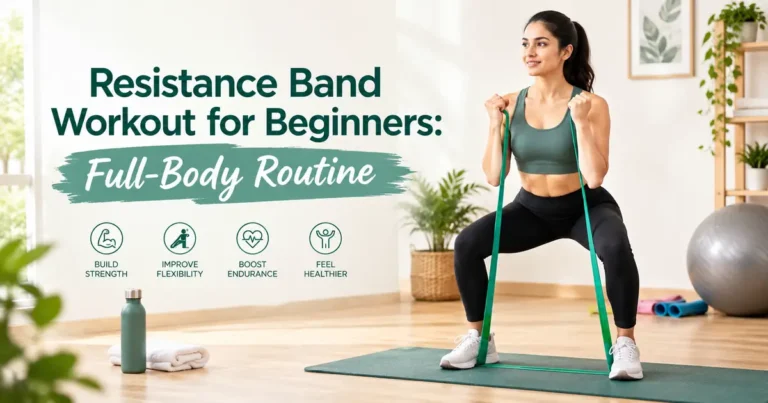
If you’re ready for the next step, see our resistance band workout for beginners.
Progress should be gradual.
You don’t need to make every workout harder than the previous one.
Common Bodyweight Exercise Technique Mistakes
Starting with advanced exercises
A difficult exercise isn’t automatically a better exercise.
Choose a variation that matches your current ability.
Moving too quickly
Fast repetitions can make it harder to control your movement.
Slow down and learn the pattern first.
Chasing repetitions
If your form breaks down at repetition 10, performing five more poor-quality repetitions doesn’t necessarily improve the workout.
Ignoring range of motion
Don’t force a movement into a range you cannot comfortably control.
Holding your breath
Try to breathe normally throughout the exercise rather than repeatedly holding your breath.
Never progressing
Bodyweight training can become repetitive if you never change the challenge.
Once a movement becomes easy, consider increasing repetitions, sets, control or difficulty.
Training hard every day
More exercise isn’t automatically better.
Your body needs recovery, particularly after demanding strength sessions.
Bodyweight Workout Safety Tips
Before starting your workout:
- Clear enough space to move safely.
- Use a stable surface.
- Check that steps, chairs or elevated surfaces are secure before using them.
- Start with easier variations.
- Warm up with several minutes of comfortable movement if needed.
- Keep repetitions controlled.
- Breathe normally.
- Stop an exercise if you experience significant or unusual pain.
- Don’t force a range of motion.
- Increase training demands gradually.
- Give your muscles time to recover.
If you’re returning to exercise after a long period of inactivity, start with manageable amounts rather than trying to complete an advanced routine immediately.
If you have a chronic health condition, injury, disability or specific exercise restrictions, consult an appropriate healthcare professional or physical-activity specialist about what types and amounts of exercise are suitable for you.
Frequently Asked Questions
What are the best bodyweight exercises for beginners?
Useful beginner movements include squats, wall or incline push-ups, glute bridges, reverse lunges, bird dogs, dead bugs, calf raises and hip hinges. The best starting exercises are those you can perform with controlled technique and modify when necessary.
Can beginners build strength with bodyweight exercises?
Yes. Bodyweight movements can provide resistance for muscle-strengthening activity. As you become stronger, you can increase repetitions, sets, range of motion, movement control or exercise difficulty.
Can I do bodyweight exercises every day?
You don’t need to perform a demanding full-body strength workout every day. Beginners can start with two full-body sessions per week and use other days for walking, mobility, rest or other suitable activities.
How many bodyweight exercises should a beginner do?
You don’t need to perform all 15 exercises in every workout. Starting with approximately 6–8 movements that cover different movement patterns can be more manageable.
How long should a beginner bodyweight workout last?
A beginner session can be relatively short. Around 20–30 minutes can be enough to complete a simple warm-up, workout and rest periods without making the session unnecessarily long.
Can I do bodyweight exercises at home without equipment?
Yes. Many bodyweight exercises require no equipment. You may optionally use a stable chair, wall or low step for certain beginner variations, but make sure anything you use is secure.
How can I make bodyweight exercises harder?
You can increase repetitions, add sets, slow the movement, add pauses, increase range of motion or progress to a more challenging variation. Later, you can also introduce resistance bands or weights.
Are bodyweight exercises enough for a full-body workout?
They can form the foundation of a full-body workout when you select movements that train the major muscle groups and different movement patterns. You can also add other forms of resistance as your training progresses.
Build Your 30-Day Better Living Routine
You don’t need a complicated workout plan to start moving more.
What matters is creating a routine you can actually follow.
Download the 30-Day Better Living Planner from InfuseUrLife and track your workouts, walking, daily movement, steps and healthy habits throughout the month.
[Download the 30-Day Better Living Planner]
Small actions. Consistent effort. A better routine.
Live better. Live smarter. Every day.
Final Takeaway
Bodyweight exercises for beginners can be an effective and practical starting point for building a consistent home workout routine.
You don’t need to master all 15 exercises immediately.
Start with a few fundamental movements such as squats, push-up variations, glute bridges, lunges and core exercises. Learn the technique, keep your repetitions controlled and choose variations that match your current ability.
Then gradually increase the challenge through more repetitions, additional sets, better control, greater range of motion or more difficult variations.
Most importantly, don’t measure a successful workout by how exhausted you feel afterward.
Measure it by whether you can perform it safely, recover from it and come back to do it again.
Start simple. Stay consistent. Progress gradually.
Your first home workout doesn’t need to be perfect.
It just needs to be the beginning.
References:
CDC — What Counts as Physical Activity for Adults
Mayo Clinic — Strength Training
ACE — Exercise Library
Mayo Clinic — Fitness Program: 5 Steps to Get Started