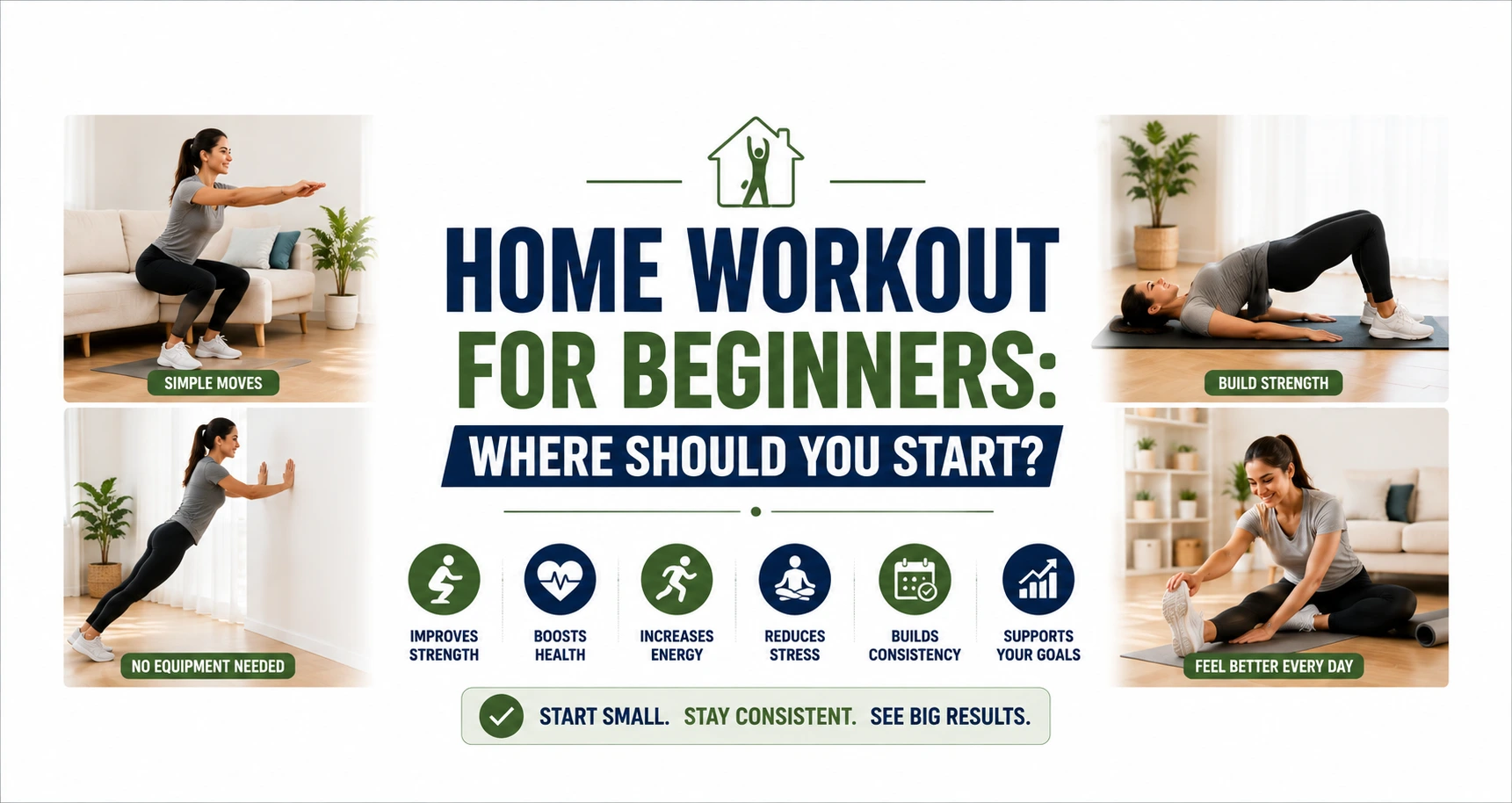
Home Workout for Beginners: Where Should You Start?
Starting a home workout for beginners can feel surprisingly confusing.
You search for beginner exercises and immediately find intense circuits, complicated programs, expensive equipment, and workouts that assume you already know how to exercise.
That is not what a beginner needs.
When you are starting from scratch, the goal is not to complete the hardest workout possible.
The goal is to learn a few basic movements, build confidence, and create a home exercise routine that you can realistically repeat.
And you do not need a home gym to begin.
A clear space, comfortable clothing, and your own bodyweight are enough for a simple starting routine.
This guide walks you through the basics and gives you a beginner-friendly full-body routine with easier and harder variations.
Important: This is general educational information, not a personalized exercise prescription. If you have a medical condition, current injury, significant pain, or concerns about whether exercise is appropriate for you, seek appropriate professional guidance before starting or progressing your routine.
Table of Contents
- Why Start With a Home Workout?
- What Beginners Actually Need
- The Basic Movement Patterns
- Home Workout for Beginners: Simple Full-Body Routine
- Beginner Exercise Modifications
- How Often Should Beginners Work Out at Home?
- A Simple Weekly Home Exercise Routine
- How to Progress Without Making Things Complicated
- Common Beginner Mistakes
- When to Stop or Modify an Exercise
- Frequently Asked Questions
- The Bottom Line
Why Start With a Home Workout?
A home workout removes many of the barriers that stop people from exercising.
You do not need to:
- Drive to a gym
- Wait for equipment
- Learn complicated machines
- Pay for a gym membership
- Spend an hour commuting
- Feel self-conscious around experienced exercisers
You can simply clear a small amount of space and begin.
That convenience matters.
The CDC recommends that adults get at least 150 minutes of moderate-intensity aerobic activity each week and perform muscle-strengthening activity on at least two days per week. It also emphasizes that some physical activity is better than none.
A home workout can help provide the muscle-strengthening component of a broader active lifestyle.
It does not have to replace walking, cycling, running, sports, or other activities.
Think of it as one part of your weekly movement routine.
What Do Beginners Actually Need?
Much less than you might think.
For a basic beginner home workout, you can start with:
A small amount of space
You need enough room to move your arms and legs safely.
Comfortable clothing
Wear something that allows unrestricted movement.
A stable surface
Avoid exercising on a slippery surface.
A chair or wall
These can be useful for beginner modifications.
Optional mat
A mat can make floor exercises more comfortable, but it is not essential.
A little time
You do not need to start with a one-hour workout.
A short, manageable session can be enough to learn the movements and establish the habit.
The Basic Movement Patterns
Instead of memorizing dozens of exercises, start by understanding a few fundamental movement patterns.
These give you a simple framework for creating a balanced full-body routine.
| Movement Pattern | Beginner Exercise | Main Areas Involved |
|---|---|---|
| Squat | Chair squat | Legs and hips |
| Push | Wall push-up | Chest, shoulders, arms |
| Hinge | Hip hinge | Hips and back |
| Step | Supported step-up | Legs and hips |
| Core stability | Dead bug or modified plank | Core |
| Mobility | Gentle stretching | Major joints and muscles |
You do not need to master every pattern on your first day.
The objective is to become comfortable moving your body.
Home Workout for Beginners: A Simple Full-Body Routine
Here is a straightforward routine you can use as a starting point.
The emphasis is on controlled movement, not speed.
Beginner Home Workout
| Exercise | Starting Option | Suggested Starting Point |
| Chair squat | Sit-to-stand from a chair | 6–10 controlled repetitions |
| Wall push-up | Push against a wall | 6–10 repetitions |
| Hip hinge | Hands on hips | 6–10 repetitions |
| Supported step-up | Low, stable step | 5–8 each side |
| Dead bug | Slow alternating limbs | 4–8 each side |
| Glute bridge | Bodyweight | 6–10 repetitions |
| Gentle mobility | Easy stretches | 3–5 minutes |
These ranges are starting examples, not mandatory targets.
If you are completely new to exercise, you can perform fewer repetitions or stop sooner.
If the routine feels easy after you have practiced it consistently, you can gradually increase the challenge.
1. Chair Squat
A chair squat is a beginner-friendly way to learn the basic squatting movement.
How to do it
- Stand in front of a stable chair.
- Place your feet approximately hip-width apart.
- Push your hips back slowly.
- Bend your knees and lower toward the chair.
- Lightly touch the chair or sit down with control.
- Stand back up.
Keep the movement comfortable.
Easier modification
Use a higher chair or reduce the depth of the squat.
You can also use your hands for support if necessary.
Progression
As you become comfortable, move toward a bodyweight squat without sitting fully on the chair.
2. Wall Push-Up
Traditional floor push-ups can be challenging for beginners.
A wall push-up changes the angle and reduces the load.
How to do it
- Stand facing a wall.
- Place your hands on the wall around chest height.
- Step back slightly.
- Bend your elbows and bring your chest toward the wall.
- Push yourself back to the starting position.
Keep your body relatively straight rather than bending at the waist.
Easier modification
Stand closer to the wall.
Progression
Move your feet farther away from the wall as you become stronger.
Eventually, you can progress to a higher surface such as a sturdy countertop or bench, then explore floor push-ups if appropriate.
3. Hip Hinge
The hip hinge teaches you to move from your hips while keeping your torso controlled.
It is a useful movement pattern for everyday activities as well as exercise.
How to practice it
- Stand with your feet comfortably apart.
- Place your hands on your hips.
- Keep your spine in a comfortable neutral position.
- Push your hips backward.
- Allow your torso to lean forward naturally.
- Return to standing by driving your hips forward.
You should feel the movement primarily around your hips rather than trying to bend deeply through your lower back.
Easier modification
Practice the movement with your back near a wall and focus on gently moving your hips toward it.
4. Supported Step-Up
A step-up introduces single-leg movement without requiring complicated equipment.
Use a low, stable step and hold a secure support if necessary.
How to do it
- Stand facing the step.
- Place one foot firmly on it.
- Step up under control.
- Bring the other foot up.
- Step back down carefully.
- Repeat on the other side.
Modification
Use a lower step.
If balance is difficult, hold a stable support.
If you cannot perform the movement comfortably, replace it with another simple lower-body movement such as a chair squat.
5. Dead Bug
The dead bug is a useful beginner core exercise because it encourages controlled movement rather than fast repetitions.
Basic version
- Lie on your back.
- Bend your knees.
- Keep your movements slow.
- Gently brace your abdomen.
- Alternate moving one arm or leg while keeping the rest of your body controlled.
Easier modification
Move only one limb at a time.
You can also practice gentle abdominal bracing without moving your limbs until the basic position feels comfortable.
6. Glute Bridge
The glute bridge is a simple floor-based movement.
How to do it
- Lie on your back with knees bent.
- Place your feet comfortably on the floor.
- Keep your arms relaxed.
- Lift your hips gently.
- Pause briefly.
- Lower with control.
Do not worry about lifting as high as possible.
A comfortable range of motion is more important than forcing the movement.
Modification
Reduce the range of movement.
If lying on the floor is uncomfortable, choose another lower-body exercise that feels suitable.
7. Gentle Mobility and Stretching
Finish with a few comfortable movements rather than immediately rushing into the rest of your day.
You might include:
- Gentle shoulder movements
- Easy chest opening
- Hip mobility
- Calf stretching
- Hamstring stretching
- Gentle upper-back movement
Do not force a stretch.
You should feel mild tension, not sharp pain.
For a more detailed flexibility session, see our Beginner Stretching Routine.
Beginner Home Workout: How to Put It Together
You do not need to perform the routine as a fast circuit.
For your first few sessions, prioritize learning the movements.
A simple structure could look like this:
Step 1: Warm up
Spend several minutes moving comfortably.
Try:
- Walking around the room
- Marching gently in place
- Shoulder circles
- Easy leg movements
Step 2: Main exercises
Move through the exercises slowly.
Take enough rest between exercises to maintain control.
Step 3: Cool down
Finish with relaxed movement and gentle mobility.
Step 4: Record how it felt
You can simply note:
Easy / manageable / challenging / too difficult
This gives you useful information for your next session.
Beginner Modifications: Make the Exercise Fit You
One of the biggest mistakes beginners make is assuming they must perform an exercise exactly as demonstrated.
You do not.
A modification is not a failure.
It is a way of adjusting an exercise to your current ability.
If squats are difficult
Use a chair and reduce the depth.
If push-ups are difficult
Use a wall instead of the floor.
If balance is difficult
Use a stable support.
If floor exercises are uncomfortable
Choose standing alternatives.
If the number of repetitions feels excessive
Stop earlier.
If an exercise causes pain
Do not simply force more repetitions.
Change or stop the movement and reassess.
The goal is to create a sustainable starting point, not to prove how much discomfort you can tolerate.
How Often Should Beginners Work Out at Home?
There is no need to exercise hard every day.
A beginner can focus on establishing a manageable weekly rhythm.
For adults, current guidance recommends muscle-strengthening activities involving the major muscle groups on at least two days each week.
That does not mean every beginner should immediately perform intense strength workouts twice a week.
Start at a level that allows you to learn the movements and recover appropriately.
Your broader week can include walking and other aerobic activities as well.
A Simple Weekly Home Exercise Routine
Here is one example of how a beginner might structure movement across a week:
| Day | Activity | Focus |
| Monday | Beginner home workout | Full body |
| Tuesday | Easy walk | General movement |
| Wednesday | Rest or gentle mobility | Recovery |
| Thursday | Beginner home workout | Full body |
| Friday | Easy walk | General movement |
| Saturday | Optional light activity | Enjoyable movement |
| Sunday | Rest or gentle mobility | Recovery |
This is an example framework, not a personalized prescription.
You can change the days according to your schedule.
The important principle is balance.
You do not need seven hard workout days.
How to Progress Without Making Things Complicated
Beginners often make the mistake of changing everything at once.
More exercises.
More repetitions.
Less rest.
Longer workouts.
More days.
That is unnecessary.
Instead, progress one variable at a time.
Option 1: Improve control
Perform the same exercise with better technique.
Option 2: Add a few repetitions
If your current workload feels comfortable, gradually add repetitions.
Option 3: Increase range of motion
For some exercises, you can gradually move through a larger comfortable range.
Option 4: Choose a harder variation
For example:
Wall push-up → elevated push-up → floor push-up
Option 5: Add another set
Once the basic routine becomes manageable, you may add another round rather than dramatically increasing everything else.
Progress does not have to be dramatic to be meaningful.
What Counts as Strength Training at Home?
You do not need dumbbells or gym machines for an exercise to strengthen your muscles.
The CDC includes bodyweight exercises such as push-ups and sit-ups among examples of muscle-strengthening activities.
Other options include:
- Squats
- Lunges
- Push-ups
- Step-ups
- Glute bridges
- Planks
- Resistance-band exercises
- Exercises using appropriate household resistance
The key is that your muscles are working against resistance.
For a broader collection of movements, see our guide to Bodyweight Exercises.
Do You Need Equipment for a Beginner Home Workout?
No.
You can begin with bodyweight exercises.
As you progress, equipment can provide additional options.
For example:
- Resistance bands
- Dumbbells
- A yoga mat
- A sturdy step
- An exercise bench
But equipment should solve a specific problem.
Do not buy a room full of equipment before you know whether you will use it.
Build the habit first.
Then decide whether additional equipment would genuinely improve your routine.
Common Beginner Mistakes
1. Starting Too Hard
The first workout feels exciting, so you do too much.
Then you are extremely sore and do not want to exercise again.
A better strategy is to finish your first sessions feeling that you could have done a little more.
2. Copying Advanced Workouts
A workout being popular online does not mean it is appropriate for someone starting from scratch.
Beginners need simpler movements and more room to learn.
3. Focusing Only on Repetitions
Twenty poor-quality repetitions are not necessarily better than eight controlled ones.
Focus on how you move.
4. Skipping Rest
Rest is part of training.
You do not need to turn every workout into a race.
5. Chasing Soreness
Being extremely sore is not proof that a workout was effective.
A successful beginner workout is one that helps you build a routine you can repeat.
6. Changing the Plan Every Day
If you constantly search for a new workout, you never give yourself enough time to become comfortable with the basic movements.
Repeat a simple routine long enough to learn it.
7. Treating One Missed Workout as Failure
Missed a session?
Return to your routine at the next opportunity.
One missed workout does not erase your progress.
How to Make Your Home Exercise Routine Easier to Maintain
The most effective beginner routine is usually the one with the fewest unnecessary barriers.
Try these strategies:
Keep your equipment visible
If you use a mat, resistance band, or other equipment, keep it somewhere accessible.
Choose a regular time
You do not need the perfect time.
You need a time you can usually protect.
Keep the first workouts short
Short sessions can make starting easier.
Prepare your space
Remove anything that could cause you to trip or restrict movement.
Track your sessions
A simple check mark can be enough.
Focus on consistency
Your first goal is not transformation.
It is repetition.
What About Walking Alongside Home Workouts?
Walking and strength training can complement each other well.
A home workout can provide muscle-strengthening activity while walking can help you accumulate aerobic activity and general movement.
Current adult activity guidance recommends both aerobic activity and muscle-strengthening work rather than treating them as interchangeable.
This is also where your existing Infuse Ur Life Walking content fits naturally.
You can learn more about the Benefits of Walking and use our guide on How to Increase Your Daily Steps Without a Gym to make everyday movement easier.
If you prefer walking as your primary form of aerobic activity, you can still build a useful home strength routine alongside it.
What If You Only Have 10 Minutes?
Use the time.
You do not need to wait for a perfect 45-minute window.
A 10-minute session could include:
2 minutes: gentle warm-up
6 minutes: a few simple bodyweight movements
2 minutes: relaxed mobility
The exact structure can vary.
The point is to remove the idea that exercise only counts when you have a large block of free time.
The CDC explicitly notes that physical activity can be spread throughout the week and that some activity is better than none.
What If You Have 30 Minutes?
You can use a longer session to spend more time warming up, practicing movements, resting between exercises, and completing additional rounds.
For a more structured session, see our 30-Minute Full-Body Home Workout.
That article can serve as the next step once you are comfortable with the basic movements in this beginner guide.
When Should You Stop or Modify an Exercise?
Exercise can involve effort, but you should not assume that every uncomfortable sensation should be ignored.
Stop or modify an exercise if:
- You experience sharp or significant pain
- You feel faint or unusually unwell
- Your technique is breaking down substantially
- A movement consistently aggravates a known problem
- You cannot control the movement safely
If you have a chronic health condition, disability, current injury, or other concern that affects exercise, appropriate professional advice can help you determine what types and amounts of activity are suitable. The CDC specifically advises people with chronic conditions or disabilities to discuss activity choices with a healthcare professional when needed.
This article is designed to help you understand the basics, not replace individualized care.
A 7-Day Beginner Home Workout Checklist
If you want a simple way to get started, use this as your first-week framework.
- Day 1: Clear a safe workout space
- Day 2: Practice chair squats and wall push-ups
- Day 3: Take an easy walk or do gentle mobility
- Day 4: Try the complete beginner routine
- Day 5: Rest or take an easy walk
- Day 6: Repeat the beginner routine if comfortable
- Day 7: Review what felt easy, difficult, or enjoyable
The purpose of the first week is familiarity, not maximum fitness.
You are learning how to make exercise part of your routine.
Frequently Asked Questions
Is a home workout enough for beginners?
A home workout can be an effective way to begin regular muscle-strengthening activity. Bodyweight exercises can provide resistance without gym equipment. A complete activity routine should also consider aerobic activity and other forms of movement.
Can I do a beginner home workout without equipment?
Yes. Exercises such as chair squats, wall push-ups, step-ups, glute bridges, and core exercises can be performed with little or no equipment.
How long should a beginner home workout be?
There is no universal required duration. Start with an amount of time you can perform comfortably and consistently. Even short sessions can be useful when building the habit.
Should beginners work out every day?
Not necessarily. A beginner can include movement on most days while allowing appropriate recovery from muscle-strengthening sessions. Current adult guidelines recommend muscle-strengthening activity on at least two days per week, not necessarily every day.
Do I need to stretch before exercising?
A few minutes of easy movement can help you transition into your workout. Longer stretching can be included separately or after exercise depending on your routine and preferences. Avoid forcing stretches.
Can I combine home workouts with walking?
Yes. Walking and home strength exercises serve different purposes and can complement each other within a weekly activity routine.
The Bottom Line
A home workout for beginners does not need to be complicated.
You do not need a gym.
You do not need expensive equipment.
You do not need to complete an intense workout every day.
Start by learning a few basic movement patterns:
Squat. Push. Hinge. Step. Stabilize. Move.
Use easier variations when necessary.
Progress gradually.
Give yourself time to learn.
And remember that a successful beginner routine is not the workout that leaves you exhausted.
It is the workout that makes you think:
“I can do that again.”
As you become more comfortable, you can increase the challenge, add equipment, explore more exercises, or move toward a longer structured routine.
The goal is to make exercise a normal part of your life—not another short-lived challenge.
Ready to Build a Better Routine?
Starting is easier when you can see your progress.
Use the 30-Day Better Living Planner to track your home workouts, walking, daily movement, and other healthy habits.
Download the 30-Day Better Living Planner and turn your first workout into the beginning of a routine you can maintain.
References:
CDC — Adult Activity Guidelines: supports the 150-minute aerobic and 2-day muscle-strengthening recommendations. CDC Adult Activity Guidelines
CDC — Adding Physical Activity as an Adult: particularly useful for the “start where you are / some activity is better than none / choose activities you enjoy” guidance. CDC: Adding Physical Activity as an Adult
CDC — What Counts as Physical Activity: supports the use of bodyweight exercises such as push-ups and sit-ups as muscle-strengthening activities. CDC: What Counts as Physical Activity
WHO — Physical Activity: supports the broader recommendation for aerobic activity plus muscle-strengthening activity involving major muscle groups. WHO Physical Activity Guidelines