
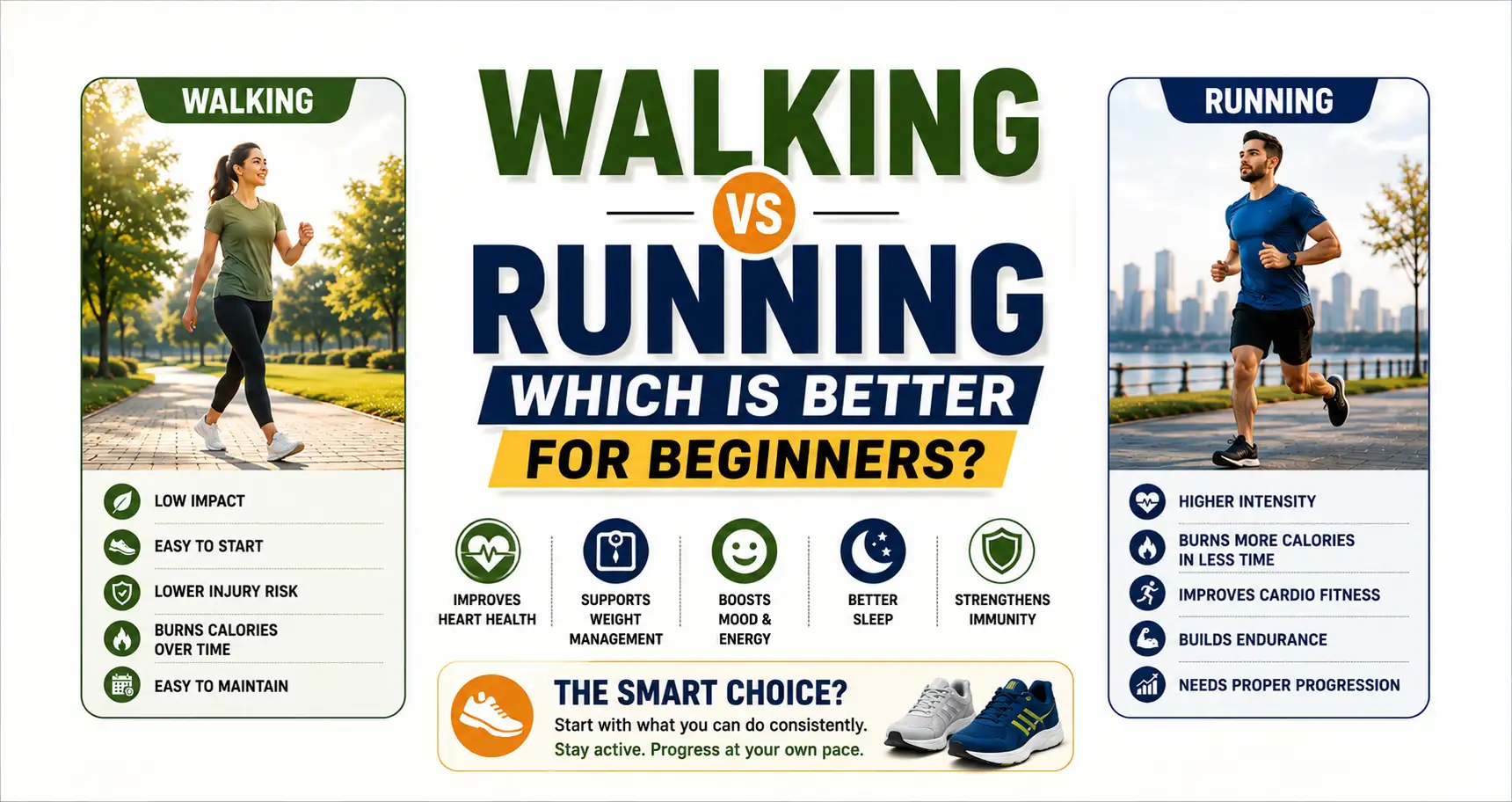
Walking vs Running: Which Is Better for Beginners?
If you are trying to become more active, the walking vs running debate can make the choice seem more complicated than it needs to be.
Running looks efficient. You can cover more distance in less time and get your heart rate up quickly.
Walking, on the other hand, seems almost too simple to count as exercise.
But simplicity is exactly what makes walking such a strong starting point for many beginners.
The better choice depends on your current fitness, goals, schedule, preferences, and how your body responds to exercise.
You do not have to run to become fit.
And you do not have to stay with walking forever if you eventually want to run.
For many beginners, the smartest approach is to start with the activity you can perform consistently, then progress when you are ready.
This guide compares walking and running so you can make that decision without falling for exaggerated claims about either one.
Table of Contents
- Walking vs running: what is the real difference?
- Walking vs running comparison
- Is walking better for beginners?
- Is running better for beginners?
- Walking vs running for weight management
- Walking vs running for cardiovascular fitness
- What about injury risk?
- Which activity is easier to maintain?
- What equipment do you need?
- Should beginners walk before running?
- A simple beginner progression
- How to choose between walking or running
- Frequently asked questions
- The bottom line
Walking vs Running: What Is the Real Difference?
The simplest difference is intensity.
Walking is generally a lower-impact, moderate-intensity activity when performed at a brisk enough pace.
Running is a higher-impact, vigorous-intensity activity.
That means running can provide a stronger cardiovascular challenge in a shorter period.
But higher intensity also comes with a greater physical demand.
The CDC notes that walking for exercise has a substantially lower injury rate than running and describes walking as a moderate-intensity, low-impact activity.
That does not mean running is unsafe.
Millions of people run regularly without problems.
It means that beginners should consider the additional physical demands when deciding where to start.
Walking vs Running: Simple Comparison
| Factor | Walking | Running |
|---|---|---|
| Intensity | Usually moderate when brisk | Usually vigorous |
| Impact | Lower | Higher |
| Beginner-friendly | Very high | Depends on current fitness |
| Time required | Usually more time for equivalent energy expenditure | Usually less time |
| Joint and muscle loading | Generally lower | Generally higher |
| Injury considerations | Lower overall injury rate | Higher injury risk, especially for novice runners |
| Equipment | Comfortable walking shoes | Suitable running shoes recommended |
| Progression | Easy to increase duration and pace | Requires more attention to progression and recovery |
| Social accessibility | Easy for most people | Fitness differences can become noticeable |
| Best starting point | Excellent for many beginners | Better for people ready for higher impact |
| Main advantage | Accessible and sustainable | Higher intensity in less time |
This table is a practical comparison, not a claim that one activity is universally better.
Is Walking Better for Beginners?
For many people, yes.
But “better” needs context.
If you are new to exercise, walking allows you to start moving without immediately taking on the impact and intensity associated with running.
It can also be easier to fit into everyday life.
You can walk:
- Around your neighbourhood
- During a lunch break
- To nearby errands
- While taking a phone call
- After a meal
- On a treadmill
- With a friend or family member
You do not need to be particularly athletic before you begin.
That accessibility is a major advantage.
The CDC’s physical activity guidance also identifies walking as one of the activities with the lowest injury rates among commonly performed forms of exercise.
Walking may be the better starting point if you:
- Have been inactive for a while
- Are new to structured exercise
- Want to build a consistent habit
- Prefer lower-impact activities
- Have limited exercise experience
- Want to gradually improve your fitness
- Do not enjoy running
- Have a schedule that makes short walking sessions easier
If you are completely new to walking, start with our Walking for Beginners: A Simple Step-by-Step Guide.
Is Running Better for Beginners?
Not necessarily.
Running can be an excellent form of exercise, but being more intense does not automatically make it the better starting point.
Running places greater demands on your muscles, joints, connective tissues, cardiovascular system, and recovery.
That is especially relevant when someone goes from very little activity to running several kilometres.
A systematic review found a higher running-related injury incidence among novice runners compared with recreational runners, although injury definitions and study populations varied.
Another systematic review covering more than 23,000 runners found that running injuries are common across different runner populations and that the evidence linking specific training variables to injuries is inconsistent.
So the lesson is not:
“Running is dangerous.”
It is:
“Running deserves a gradual introduction.”
Running may suit you if you:
- Already have a reasonable fitness base
- Enjoy running
- Want a higher-intensity workout
- Have limited time for exercise
- Can recover comfortably between sessions
- Are willing to progress gradually
- Have no current injury limiting your activity
Walking vs Running for Beginners: Which Burns More Calories?
Running generally uses more energy per minute than walking because it requires greater effort.
But that does not automatically make running the better choice for managing body weight.
The practical question is:
Which activity can you perform consistently?
Suppose you run for 20 minutes but dislike it so much that you do it once a week.
Now compare that with someone who enjoys walking and takes a brisk 40-minute walk five days a week.
The second person may accumulate considerably more activity across the week.
This is why calorie comparisons should not be viewed in isolation.
Your overall activity, food intake, sleep, recovery, and long-term consistency all matter.
Research comparing walking and running has found favourable associations between both forms of activity and health outcomes in certain populations. These studies are observational, however, so they should not be interpreted as proof that walking or running alone causes a specific health outcome.
Walking vs Running for Cardiovascular Fitness
Both walking and running can contribute to cardiovascular fitness.
The major difference is how much intensity you can generate in a given amount of time.
A brisk walk may provide moderate-intensity activity.
Running generally reaches vigorous intensity more easily.
For adults, current U.S. physical activity guidelines recommend at least 150 minutes of moderate-intensity aerobic activity per week, or 75 minutes of vigorous-intensity activity, or an equivalent combination.
That means you can build a healthy activity routine without becoming a runner.
Walking can absolutely be part of an effective exercise routine.
And if you eventually want to run, walking can provide a practical foundation from which to progress.
What About Injury Risk?
This is one of the most important differences in the walking vs running comparison.
Running is a higher-impact activity.
For beginners who suddenly increase their running volume, the body may not have had enough time to adapt.
A systematic review and meta-analysis reported an injury incidence of about 17.8 injuries per 1,000 hours among novice runners compared with about 7.7 per 1,000 hours among recreational runners. The researchers also noted limitations caused by differences in injury definitions and study methods.
The broader evidence does not support one simple formula for predicting who will get injured.
Running injuries are multifactorial.
Your training history, previous injuries, recovery, fitness, running exposure, and other factors can all matter.
That is why gradual progression is more sensible than going from almost no activity to running every day.
Walking has an advantage here
Walking generally places less impact on the body than running and has a lower reported injury rate.
That makes it a particularly useful option for people who are just beginning an exercise habit.
If you experience persistent pain or have a medical condition that affects exercise, get appropriate professional advice rather than trying to push through it.
Which Is Easier to Maintain?
This may be the most important question in the entire article.
Walking is usually easier to maintain for beginners because it requires less recovery and can be incorporated into everyday activities.
You can walk to a shop.
You can walk after lunch.
You can walk during a phone call.
You can take a short walk when you have 10 minutes available.
Running usually requires a more deliberate training decision.
You need to think about:
- Pace
- Distance
- Recovery
- Running surfaces
- Footwear
- Training progression
- How your body feels between sessions
None of that makes running bad.
It simply means running may require more planning.
For someone starting from a low activity level, the activity with the lowest barrier to repetition often has the biggest practical advantage.
What Equipment Do You Need?
One of walking’s biggest advantages is its simplicity.
You generally need:
- Comfortable clothing
- Suitable footwear
- A safe place to walk
A fitness tracker can be useful, but it is optional.
For running, suitable footwear becomes more important because of the additional impact and repetitive loading.
This does not mean you need to buy the most expensive running shoes available.
Fit, comfort, and suitability for your individual needs matter more than simply choosing the most heavily marketed shoe.
If you are specifically looking for footwear for walking, see our guide to Best Walking Shoes.
Should Beginners Walk Before Running?
For many beginners, walking first is a sensible option.
It gives you a chance to establish a movement habit and discover how your body responds to regular activity.
You can then introduce short running intervals if you want to progress.
For example:
Stage 1: Build a walking habit
Walk comfortably for 20–30 minutes several times per week.
Stage 2: Increase brisk walking
Add periods where you walk faster while still maintaining control.
Stage 3: Introduce short running intervals
Try:
1 minute easy running + 3 minutes walking
Repeat several times.
Stage 4: Gradually increase running
Over time, you can increase the running portions while reducing the walking portions.
You do not need to rush through these stages.
The appropriate progression depends on your current fitness and how your body responds.
A Simple Walking-to-Running Progression
Here is an example for someone who already feels comfortable walking regularly:
| Week | Walking | Running | Main Goal |
| 1 | 25–30 min | None | Establish consistency |
| 2 | 25–30 min | 1 min × 3 | Introduce running gently |
| 3 | 25–30 min | 1–2 min intervals | Build tolerance |
| 4 | 25–30 min | 2 min intervals | Gradually extend running |
| 5+ | Adjust gradually | Increase only if comfortable | Find sustainable balance |
This is an example framework, not a medical or individualized training prescription.
If running causes pain that does not settle with rest, do not simply continue increasing the workload.
Walking or Running: Which Should You Choose?
Use this simple decision guide.
Choose walking if:
You want the easiest starting point.
Walking is a strong choice if your main goal is to become more active consistently.
Choose running if:
You already have a reasonable fitness base and enjoy higher-intensity exercise.
Running may allow you to achieve vigorous-intensity activity in less time.
Choose a combination if:
You want the benefits of both.
You can walk on some days and run on others.
Or you can combine walking and running within the same session.
There is no rule saying you have to identify yourself as either a “walker” or a “runner.”
What If Your Goal Is Weight Loss?
This is where many people get trapped by the walking vs running debate.
They assume running must automatically be better because it burns more calories per minute.
That is too simplistic.
Weight loss depends primarily on sustained energy balance, and physical activity can support it.
Running can increase energy expenditure efficiently because it is more intense.
But walking has a major practical advantage: many people can perform it frequently without needing as much recovery.
If you can comfortably walk for longer periods and do it consistently, walking can become a useful part of a weight-management routine.
If you enjoy running and your body tolerates it well, running can also be valuable.
The better choice is the one that works with your overall lifestyle.
What If You Want to Improve Your Daily Step Count?
Then walking has an obvious advantage.
Everyday walking contributes directly to your step count.
You can accumulate steps through:
- Commuting
- Shopping
- Household activities
- Walking breaks
- Short walks
- Walking after meals
- Recreational walks
Running also produces steps, but most people do not use running as their primary strategy for accumulating everyday steps.
If your goal is simply to become more active throughout the day, walking is often the more natural tool.
Our guide on the Benefits of Walking Every Day covers the broader role walking can play in an active lifestyle.
Walking vs Running: A Beginner’s Decision Checklist
Before choosing, ask yourself:
- Am I currently active?
- Can I comfortably walk for 20–30 minutes?
- Do I actually enjoy running?
- Do I have enough time for regular running and recovery?
- Am I willing to progress gradually?
- Do I have any current pain or injury that affects exercise?
- Is my main goal general activity, fitness, weight management, or running performance?
- Would walking be easier for me to repeat consistently?
- Would combining walking and running suit me better?
- Do I have comfortable, appropriate footwear?
If most of your answers point toward simplicity and consistency, start with walking.
If you already have a fitness base and genuinely want to run, introduce running progressively.
Frequently Asked Questions
Is walking better than running for beginners?
Walking is often the more accessible starting point for beginners because it is lower impact, easier to recover from, and simple to incorporate into everyday life. That does not make it universally better; a fit beginner who enjoys running may be able to start with a gradual running program.
Is running more effective than walking?
“More effective” depends on the goal. Running generally provides greater intensity in less time, while walking is easier to sustain for many beginners and has a lower injury rate.
Can walking prepare you for running?
Yes. Regular walking can help you establish consistency and improve your general activity level. When you are comfortable, you can introduce short running intervals and gradually increase them.
Should I walk or run every day?
You do not need to run every day to benefit from running. Beginners should allow appropriate recovery and progress gradually. Walking can generally be incorporated more frequently because it is lower impact.
Can I lose weight by walking instead of running?
Walking can contribute to a weight-management plan by increasing energy expenditure and physical activity. Your overall diet, activity level, and consistency also matter.
What shoes should beginners wear?
Choose comfortable footwear appropriate for the activity and your environment. If you are primarily walking, our Best Walking Shoes guide can help you compare options.
The Bottom Line: Walking vs Running
So, walking vs running—which is better for beginners?
For many beginners, walking is the better place to start.
It is accessible, lower impact, easy to incorporate into daily life, and generally associated with a lower injury rate than running.
Running has its own advantages.
It is more vigorous, can provide a substantial cardiovascular challenge in less time, and can be an excellent choice for people who enjoy it and have built enough fitness to handle the additional physical demands.
But you do not have to choose one forever.
A beginner can start with walking, build consistency, add brisk walking, and eventually introduce short running intervals.
The real goal is not to choose the activity that sounds hardest.
Choose the activity you can perform consistently, then build from there.
If that is walking, start walking.
If you eventually want to run, earn the transition gradually.
Ready to Build a Consistent Walking Habit?
You do not need to transform your fitness routine overnight.
Start with a manageable walk, build consistency, and gradually increase your activity as you become more comfortable.
The 30-Day Better Living Planner can help you track your walking, daily movement, and other healthy habits in one place.
Download the 30-Day Better Living Planner and turn small daily actions into a routine you can actually maintain.
References:
https://www.cdc.gov/physical-activity/media/pdfs/Physical_Activity_Guidelines_2nd_edition.pdf
https://pubmed.ncbi.nlm.nih.gov/25951917/
https://pubmed.ncbi.nlm.nih.gov/34478518/
https://pubmed.ncbi.nlm.nih.gov/23940195/
https://pubmed.ncbi.nlm.nih.gov/24968127/