
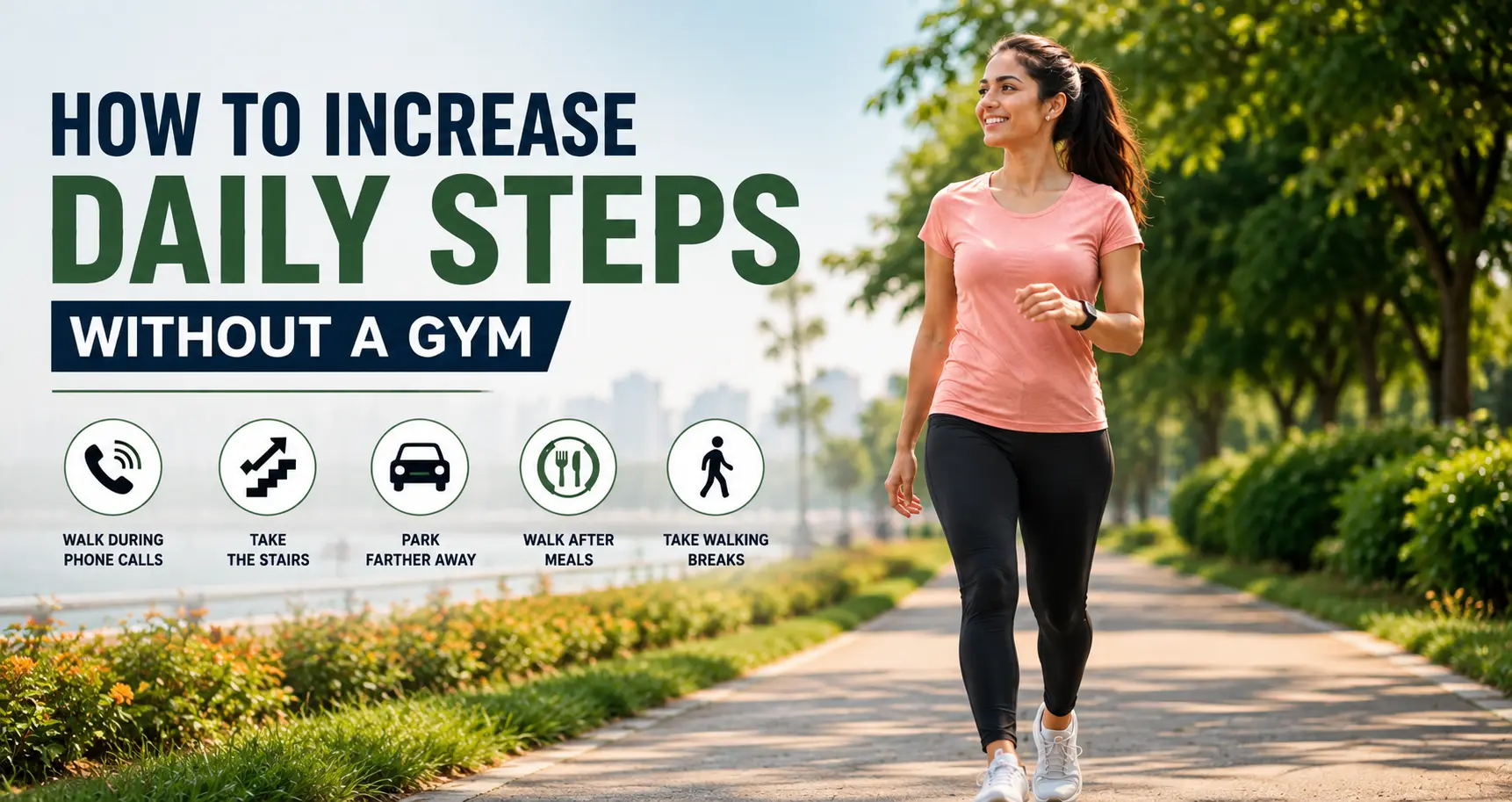
How to Increase Daily Steps Without a Gym
Learning how to increase daily steps does not require a gym membership, expensive equipment, or an hour of free time every day.
In fact, some of the easiest ways to get more steps every day come from changing what you already do.
Walk while taking a phone call. Take the stairs instead of the lift. Park a little farther away. Take a short walk after a meal. Add a few minutes of walking between periods of sitting.
These small decisions can quietly add hundreds or thousands of steps to your day.
And you do not have to jump straight to 10,000 steps.
If your current activity level is low, a modest increase can be a sensible place to start. WHO specifically recommends that people who are not meeting activity guidelines begin with small amounts of physical activity and gradually increase the frequency, intensity, and duration over time.
The goal of this guide is simple: make walking more automatic and less dependent on motivation.
Table of Contents
- Do You Need a Gym to Walk More?
- Start by Measuring Your Current Steps
- 15 Practical Ways to Increase Daily Steps
- Use Your Existing Routine as a Walking Trigger
- How to Increase Daily Steps at Work
- How to Get More Steps at Home
- How to Increase Daily Steps Outside
- A Simple 7-Day Step-Building Checklist
- How Many Extra Steps Should You Add?
- What If You Miss Your Goal?
- The Bottom Line
Do You Need a Gym to Walk More?
No.
A gym can be useful for structured exercise, strength training, or other workouts, but it is not necessary for increasing your daily step count.
Walking is one of the easiest forms of physical activity to incorporate into transportation, work, household tasks, and leisure. WHO specifically recognizes walking and everyday activities as forms of physical activity.
That distinction matters because many people think exercise has to be a separate event:
Work → commute → dinner → workout → sleep.
If you already struggle to find time for exercise, adding another appointment to your day may not be realistic.
Instead, try:
Work + walking.
Commute + walking.
Phone calls + walking.
Shopping + walking.
Breaks + walking.
You are not necessarily creating more time.
You are using some of the time you already have differently.
Start by Measuring Your Current Steps
Before trying to increase your steps, find out what you currently do.
Check your phone, smartwatch, fitness tracker, or pedometer for several ordinary days.
Do not immediately change your routine.
You want a realistic baseline.
For example, you might discover that you average:
- 2,800 steps on weekdays
- 4,500 steps on Saturday
- 5,200 steps on Sunday
Your weekly pattern tells you much more than a single unusually active day.
Once you know your baseline, choose a manageable next step.
If you average around 3,000 steps, reaching 4,000 or 4,500 consistently may be a better starting point than demanding 10,000 immediately.
For more context on choosing a realistic target, read 5000 vs 10000 Steps: What Should You Aim For?.
A simple rule
Do not start by asking, “How do I reach 10,000?”
Start by asking:
“How can I add a little more movement to the day I already have?”
15 Practical Ways to Increase Daily Steps
1. Take a 5–10 Minute Morning Walk
You do not need to begin the day with a long workout.
Put on comfortable shoes and walk around your neighbourhood for 5–10 minutes.
It can be especially useful if your day tends to become increasingly busy as it progresses.
A short morning walk also gives you an early opportunity to build momentum.
2. Walk During Phone Calls
This is one of the easiest ways to increase daily steps without creating a separate task.
Whenever the call does not require you to sit at a desk, stand up and walk.
You can walk:
- Around your home
- Around the office
- In a corridor
- Outside your building
- Around a nearby safe area
A few phone calls can turn into a surprisingly useful amount of walking.
3. Take the Stairs
If you normally take an elevator for one or two floors, consider using the stairs when practical.
This does not just add steps. It can also make the walking more physically demanding.
You do not have to turn every staircase into a workout.
Simply choosing the stairs more often can make everyday movement more active.
4. Park Farther Away
When driving somewhere, you do not always need the closest parking space.
Parking a little farther away creates an easy walking opportunity before and after your errand.
The important part is moderation.
You do not need to park half a kilometre away.
Even a small extra distance, repeated regularly, can become part of your normal routine.
5. Get Off Public Transport One Stop Earlier
If your route and surroundings are safe and practical, consider getting off one stop before your destination.
You can then walk the remaining distance.
This works particularly well when your commute already involves public transportation.
Just make sure the route is suitable for walking and that weather, traffic, and personal safety are appropriate.
6. Add a Walking Break Between Tasks
Instead of moving directly from one task to another, use the transition as a movement opportunity.
For example:
Finish email → walk for five minutes → start next task.
Or:
Finish meeting → take a short walk → return to your desk.
These small breaks can make a sedentary day less continuous.
WHO guidelines recommend limiting sedentary time and replacing sedentary behaviour with physical activity of any intensity.
7. Walk While Listening
Have a podcast, audiobook, or favourite playlist you enjoy?
Use it as a walking cue.
Instead of listening while sitting, walk around your neighbourhood or another suitable location.
You can even create a simple rule:
Favourite podcast = walking time.
That connects something you already enjoy with a healthier habit.
8. Take a Short Walk After Meals
A post-meal walk can be an easy way to attach walking to something that already happens every day.
Instead of thinking:
“I need to find time to walk.”
Think:
“After lunch, I walk for 10 minutes.”
That small change removes some of the decision-making involved.
For more information, see Benefits of Walking After Meals.
9. Walk While Waiting
Waiting time is often invisible movement time.
You might be waiting for:
- An appointment
- A friend
- A family member
- Food
- A delivery
- A meeting to begin
When appropriate, use a few of those minutes to walk rather than automatically sitting or scrolling.
You do not need to turn every waiting period into exercise.
Just recognize that some waiting time can become walking time.
10. Make Errands More Walk-Friendly
If you have several small errands in the same area, consider walking between them rather than moving your vehicle each time.
For example:
Pharmacy → grocery store → café → home
could become one walking sequence instead of several short vehicle trips.
The best opportunities are usually errands you already need to complete.
11. Walk While Doing Household Tasks
Household activities already involve movement.
You can increase that movement by being intentional about it.
Try:
- Taking smaller loads instead of one large trip
- Walking around while organizing
- Making an extra trip when it is convenient
- Doing light tidying between sedentary activities
- Walking around the house during short breaks
Do not manufacture unnecessary work just to hit a step number.
The point is to recognize movement that already fits naturally into your day.
12. Create a Walking Route Near Home
Find a simple route that takes approximately 10–20 minutes.
It could be:
- Around your neighbourhood
- Through a nearby park
- Around a residential block
- Along a suitable walking path
Knowing exactly where you will walk eliminates another common obstacle:
“Where should I go?”
A familiar route makes it easier to start.
13. Use the “One More Loop” Trick
Already walking somewhere?
Add one small loop before returning.
For example, after arriving home from a nearby shop, walk around the block before going inside.
At work, take one extra corridor loop before returning to your desk.
The additional distance may seem insignificant.
Repeated every day, however, these small extensions can become meaningful.
14. Set Walking Triggers Instead of Relying on Motivation
Motivation changes.
Triggers are more dependable.
Choose an event that happens every day and connect it to walking.
For example:
- After morning tea → walk for five minutes
- After lunch → walk for 10 minutes
- After finishing work → walk for 15 minutes
- During one phone call → walk
- Before watching television → walk around the block
The trigger tells you when to walk.
You do not have to repeatedly negotiate with yourself about whether you feel like doing it.
15. Make Walking Social
Walking with another person can make the activity more enjoyable.
Invite a friend, partner, colleague, or family member for a short walk.
You can use the time to catch up rather than treating it like a formal workout.
This can be particularly useful for people who find solo walking boring.
How to Increase Daily Steps at Work
A desk-based workday can make increasing daily steps difficult.
The solution is not necessarily a one-hour walk after work.
Instead, create multiple movement opportunities throughout the day.
Try this simple pattern:
Every 60–90 minutes
Stand up and move around for a few minutes.
During one phone call
Walk instead of sitting.
At lunchtime
Take a short walk before or after eating.
Between meetings
Walk instead of immediately opening another screen.
Before leaving work
Take a short walk if your schedule allows.
The objective is to break up long periods of sitting while gradually increasing your total movement.
And remember: step count is only one part of physical activity. Adults should also aim for at least 150 minutes of moderate-intensity aerobic activity each week, along with muscle-strengthening activity on at least two days.
How to Get More Steps at Home
You can also build movement into your home routine.
Try:
While watching television:
Walk during advertisements, between episodes, or while waiting for something to load.
While listening to music:
Walk around your home for a few songs.
While talking on the phone:
Stand and move instead of sitting.
While doing household tasks:
Take opportunities to move rather than completing everything in one trip.
Before bedtime:
Take a relaxed short walk if it fits your routine.
These are not substitutes for structured exercise when you need it.
They are simply ways to make an otherwise sedentary day more active.
How to Increase Daily Steps Outside the Home
Your environment can either make walking easy or make it inconvenient.
Look for destinations that are already within a reasonable walking distance.
For example:
- A nearby shop
- A local park
- A café
- A library
- A place of worship
- A friend’s home
- A neighbourhood market
You do not need to walk everywhere.
Choose just one journey that could reasonably become a walking trip.
Then build from there.
Your 7-Day Plan to Increase Daily Steps
The following plan is deliberately simple.
Do not try all 15 strategies on Day 1.
The goal is to build one habit at a time.
Day 1 — Find Your Baseline
Goal: Understand your current activity.
- Check your average steps from the previous few days
- Record today’s total
- Identify when you are most sedentary
- Choose one easy walking opportunity
- Take a relaxed 5–10 minute walk
Today’s focus: Awareness.
Do not worry about hitting a huge number.
Day 2 — Add a Walking Break
Goal: Introduce intentional movement.
- Take one 5–10 minute walking break
- Walk during one phone call if possible
- Record your total steps
- Notice how you feel after the walk
Today’s focus: Create one repeatable habit.
Day 3 — Walk After a Meal
Goal: Attach walking to an existing routine.
- Choose lunch or dinner as your walking trigger
- Walk comfortably for 5–15 minutes afterward
- Avoid treating the walk as an intense workout
- Record your steps
Today’s focus: Build a habit around an existing event.
Day 4 — Change One Routine
Goal: Find movement hidden inside your normal day.
Choose one:
- Take the stairs
- Park farther away
- Walk one short errand
- Get off public transport one stop earlier
- Take an additional walking loop
Today’s focus: Change one automatic decision.
Day 5 — Add a Second Walking Window
Goal: Spread your movement across the day.
- Take one short walk in the morning
- Take one short walk later in the day
- Walk during a suitable phone call
- Avoid sitting continuously for long periods when practical
Today’s focus: More movement opportunities, not one massive walk.
Day 6 — Make It Social
Goal: Make walking enjoyable.
- Invite someone for a walk
- Choose a pleasant route
- Walk for 15–30 minutes if comfortable
- Focus on enjoying the conversation or surroundings
- Record your steps
Today’s focus: Make the habit easier to repeat.
Day 7 — Review and Set Your Next Goal
Goal: Turn one week into a repeatable routine.
- Review your seven days
- Compare your average with your starting baseline
- Identify the three strategies that worked best
- Choose your favourite walking trigger
- Set a realistic goal for next week
- Schedule your walking opportunities
Today’s focus: Build the next week, not chase perfection.
Your 7-Day Step-Building Checklist at a Glance
| Day | Main Action | Simple Goal |
| Day 1 | Find your baseline | Understand current movement |
| Day 2 | Add a walking break | Create one repeatable habit |
| Day 3 | Walk after a meal | Attach walking to a routine |
| Day 4 | Change one routine | Add movement without extra planning |
| Day 5 | Add two walking windows | Spread movement across the day |
| Day 6 | Walk socially | Make walking enjoyable |
| Day 7 | Review your week | Set your next realistic goal |
Remember: the goal is not to perform this checklist perfectly. The goal is to discover which small changes fit naturally into your life.
How Many Extra Steps Should You Add?
There is no universal number of extra steps that everyone needs to add.
Your starting point matters.
Someone averaging 2,000 steps may need a different progression from someone already averaging 8,000.
A practical approach is to increase gradually and pay attention to how your body responds.
For example:
Current average: 3,000 steps
Instead of immediately demanding 10,000:
Week 1: 3,500–4,000
Week 2: 4,000–4,500
Week 3: 4,500–5,000
Week 4: Reassess
These numbers are an example rather than a prescription.
If a particular increase feels too difficult, stay at your current level for longer.
If you are already active and 5,000 steps feels easy, your progression can look completely different.
For people starting from a low activity level, gradual progression is more sensible than trying to make a dramatic jump overnight. WHO specifically advises inactive adults to start with small amounts and gradually build up.
What If You Miss Your Step Goal?
You will.
And that is normal.
A rainy day, busy work schedule, travel, fatigue, family commitments, or simply forgetting can reduce your step count.
Do not respond by trying to “make up” every missed step the following day.
Instead, return to your normal routine.
Think in terms of patterns rather than perfect days.
If you walk more consistently over several weeks, one low-step day is unlikely to matter nearly as much as abandoning the habit because you missed a target.
Your tracker is a tool.
It is not a report card.
Should You Try to Reach 10,000 Steps?
Not necessarily.
Your step goal should reflect your starting point and personal circumstances.
If you currently average 3,000 steps, increasing to 5,000 can be a useful milestone.
If you already average 7,000 or 8,000 and enjoy walking, you may choose to work toward 10,000.
But you do not need to treat 10,000 as a mandatory threshold.
Our guide on 5,000 vs 10,000 Steps: What Should You Aim For? explains why the popular 10,000-step target should not be confused with a universal scientific requirement.
The bigger objective is simple:
Move more than you do now, in a way you can maintain.
What About Beginners?
If you are completely new to regular walking, do not feel pressured to follow someone else’s step count.
Start with comfortable walks and build gradually.
Pay attention to your footwear, walking surface, pace, and how your body responds. If you’re looking for a comfortable budget option, our guide to walking shoes for men under ₹2000 can help you compare suitable choices.
Our Walking for Beginners: A Simple Step-by-Step Guide is a useful next step if you want to build a walking routine from the beginning.
And if you want a more structured habit-building approach, consider turning this seven-day experiment into a longer 30-Day Walking Challenge.
The Bottom Line
Learning how to increase daily steps does not require a gym.
The easiest approach is to stop treating walking as something that only happens during a dedicated workout.
Instead, look for opportunities throughout your existing day.
Walk during phone calls.
Take short movement breaks.
Walk after meals.
Use stairs when practical.
Park farther away.
Turn errands into walking opportunities.
Create a regular route near home.
Most importantly, start with a change you can actually maintain.
You do not need to transform your routine overnight.
A five-minute walk today can become a 10-minute habit next week. A short walk after lunch can become automatic. A few additional walking opportunities can gradually turn a sedentary day into a more active one.
That is the real goal of walking more: not perfection, but a lifestyle that makes movement easier to repeat.
Ready to Build Better Habits?
Increasing your daily steps is just one part of creating a healthier everyday routine.
Use the 30-Day Better Living Planner to track your walking, movement, and other habits for the next month.
Download the 30-Day Better Living Planner and turn small daily actions into habits that last.